
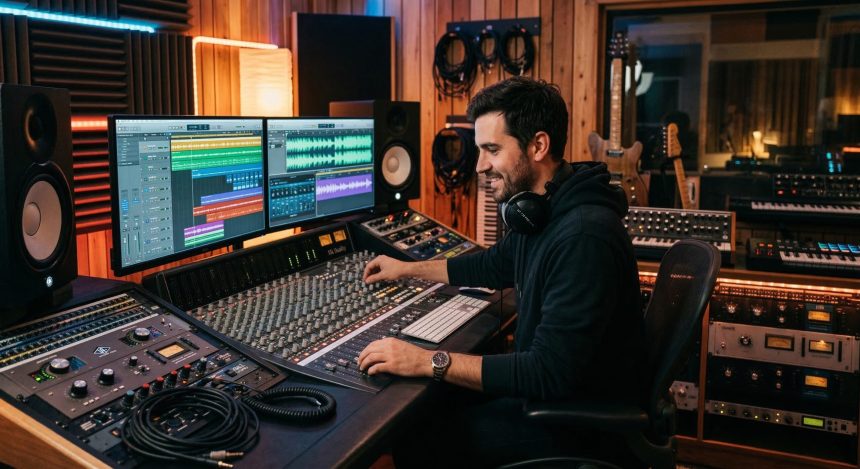
AI Tools for Music Production: Your Creative Allies
AI tools for music production represent a dynamic shift in how artists create sounds, compositions, and entire songs. These intelligent applications leverage vast databases of existing music and patterns, learning from them to offer fresh ideas, ready-made pieces, and innovative soundscapes. Let’s delve into how these innovative tools are reshaping the music-making landscape.
What AI Tools Can Do for You
At the core of AI music tools lies their versatility. Here’s a quick look at some functions they excel in:
- Drum Loops and Rhythms: Generate unique beat patterns to complement your tracks.
- Chords and Melodies: Create chord progressions and catchy melodies with just a request.
- Basslines and Arpeggios: Develop deep, resonant basslines or intricate arpeggios effortlessly.
- Mix and Master: Enhance the clarity and depth of your music through intelligent analysis and suggestions.
A standout tool, Music GPT, exemplifies how such technology can facilitate the composition process. With its ability to help structure ideas and experiment with sounds, it acts as a tireless studio assistant ready to brainstorm and refine your musical vision.
Why Producers Love AI Tools
Producers are increasingly embracing AI tools for a variety of reasons that enhance their workflow:
- Speed: AI allows for rapid experimentation with numerous ideas, reducing the time spent on demos or drafts.
- Fresh Ideas: These tools present unexpected patterns and sounds that might not occur to the creator independently.
- Less Stress: The dreaded writer’s block is alleviated, thanks to the abundance of suggestions and resources readily available.
In practical scenarios, producers can harness AI tools to:
- Request a specific chord progression that fits the mood of their project.
- Obtain unique drum patterns that complement their creative vision.
- Explore different bassline variants quickly and efficiently, ensuring they find the perfect fit for their track.
These tools serve as a canvas upon which producers can exercise their creativity by selecting, altering, and molding various components to craft a distinct piece.
Using AI for Ideas and Writer’s Block
Experiencing creative blocks is a common hurdle for many music producers. The blank screen stares back, and inspiration seems elusive. AI tools shine brightly in these moments, providing a pathway to creativity:
- Request a complex chord progression, such as a melancholic one, to evoke specific emotions.
- Generate melody lines tailored to your key and tempo, offering a starting point for composition.
- Create rhythmic drum grooves that align with your aesthetic preferences, opening avenues for further exploration.
Many producers utilize AI music generators to ignite a song idea. They might take an AI suggestion and then manually reconstruct the parts, ensuring the final product retains their unique voice. When employed in this manner, AI becomes a collaborative partner rather than just a tool.
Sound Design With AI Tools
For emerging producers, sound design can feel like a daunting task. However, AI tools have simplified this process considerably:
- Suggest synth presets tailored to the desired mood, whether you’re after a “warm pad” or a “dark lead.”
- Shape sounds to match a mix, allowing for nuanced adjustments like brightness and texture.
- Transform basic sounds into complex, rich textures that enhance the overall sonic experience.
By simply typing a request, like “soft dreamy pad,” users can receive immediate suggestions to kickstart their creativity. From there, they can tweak and refine the sounds, ensuring that every detail resonates with their artistic intent.
Helping With Mixing and Mastering
Achieving a polished mix is crucial for a track’s success, and AI plugins are changing the game in this area. These smart tools can analyze your song and offer insightful recommendations or quick fixes:
- Balance levels between instruments, ensuring harmony between kick, bass, and lead melodies.
- Identify and mitigate harsh frequencies or muddy lows to clean up your sound.
- Suggest compression settings that enhance dynamics without compromising clarity.
- Provide reference-style EQ curves for optimal shaping of your track’s overall tone.
Thinking of AI as a “second pair of ears” allows producers to hear what they might overlook. By using AI tools, they can learn about mixing and develop their skills through these insightful suggestions.
Boosting Workflow and Speed
In the fast-paced world of music production, time is of the essence. Efficient workflow can significantly impact the quality and quantity of completed projects. AI tools excel at streamlining mundane tasks:
- Automate the naming, coloring, and sorting of tracks for a more organized workspace.
- Construct basic song structure (intro, build, drop, outro) to provide a solid foundation.
- Suggest fill-ins and transitions that smooth out your composition.
- Clean up noisy vocal tracks or samples to elevate the final product.
Starting with a rough idea and allowing AI to fill in the gaps can boost workflow, encouraging producers to transform incomplete loops into finished songs.
Maintaining Your Look and Avoiding a Generic Sound
A common concern when integrating AI into music production is whether the results will sound mechanical or lacking in personality. The solution lies in how you utilize these tools. To maintain your unique sound:
- Use AI-generated content as a launchpad for your ideas rather than relying on it entirely.
- Modify sounds, rhythms, and melodies to better reflect your creative preferences.
- Incorporate your own playing and modifications into the parts generated by AI.
- Treat AI outputs as drafts that require your personal touch for refinement.
Approaching AI as a non-stop collaborator allows you to maintain artistic integrity. Ultimately, the choice of how to integrate these technologies rests in your hands, ensuring that your taste and vision remain the driving force behind your music.
Your New Studio Partner
Rather than replacing artists, smart AI tools stand alongside music producers, enhancing their creativity and workflow. By merging your unique expression with cutting-edge technology—like Music GPT and other intelligent assistants—you gain the advantages of both human intuition and advanced computational power.
As producers adapt to this new landscape, those who embrace the opportunity to refine their craft with AI tools are likely to yield a wealth of new ideas, completed tracks, and a greater chance of resonating with audiences. The evolution of music production continues, and AI is poised to be an essential part of this journey.