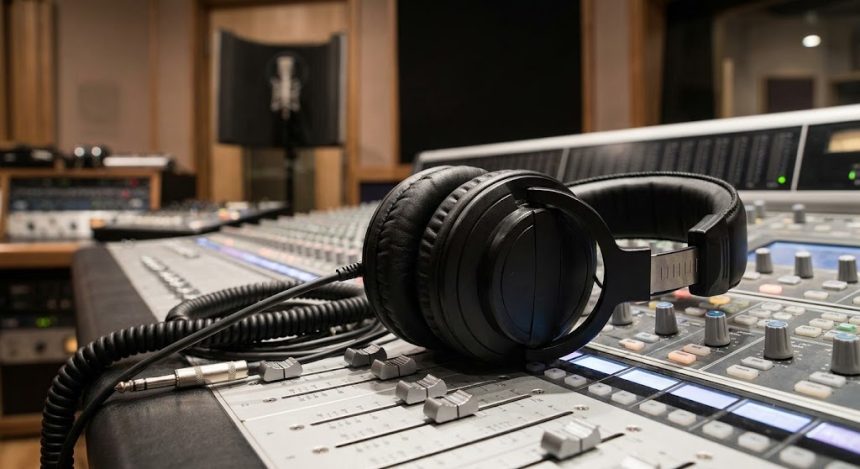
The home studio in 2026 is doing things that professional recording facilities couldn’t achieve a decade ago. The software has caught up. The audio interfaces are clean, cheap, and bus-powered. What separates a bedroom producer making genuinely competitive music from one stuck in revision hell is increasingly simple: monitoring. If you can’t hear what’s actually in your mix — if the headphones are flattering what should be fixed, or the speakers are masking low-end problems — no amount of plugin knowledge fixes the output.
This guide covers the studio monitoring gear that works at the under-$300 price point in 2026, across two categories: headphones for tracking, referencing, and headphone mixing, and studio monitors for the speakers-based mixing workflow. Every entry is sourced from tested professional reviews, has verified current pricing, and includes the specific use-case guidance that tells you which one to buy for your workflow rather than the most popular one in a generic list.
A note on monitors: studio monitors are sold as single units. Where pair pricing is relevant, it’s noted explicitly.
Quick Reference
Headphones
| Model | Type | Price | Best For | Impedance |
|---|---|---|---|---|
| Sony MDR-7506 | Closed-back | ~$99 | Budget standard; broadcast; tracking | 63Ω |
| AKG K371 | Closed-back | ~$100 | Harman-tuned accuracy; portable | 32Ω |
| Audio-Technica ATH-M50x | Closed-back | ~$150 | All-around workhorse; EDM mixing | 38Ω |
| Shure SRH840A | Closed-back | ~$150 | Balanced mids; vocals; genre-neutral | 44Ω |
| Beyerdynamic DT 770 Pro | Closed-back | ~$170 | Tracking isolation; bass extension | 80Ω or 250Ω |
| Sennheiser HD 600 | Open-back | ~$299 | Reference mixing; open soundstage | 300Ω |
Studio Monitors (price per unit; pair price noted)
| Model | Driver | Price/unit | Pair Cost | Best For |
|---|---|---|---|---|
| PreSonus Eris E3.5 BT | 3.5″ | ~$73 | ~$147 (sold as pair) | Desktop; beginners; Bluetooth |
| M-Audio BX5 D3 | 5″ | ~$120 | ~$240 | Flat, honest sound; budget pair |
| JBL 305P MkII | 5″ | ~$149 | ~$298 | Wide sweet spot; great imaging; all genres |
| Adam Audio T5V | 5″ + ribbon | ~$175 | ~$350 | Ribbon tweeter; high-freq detail |
| Yamaha HS5 | 5″ | ~$200 | ~$400 | NS10-style honesty; reference mixing |
| KRK Rokit 5 G5 | 5″ | ~$199 | ~$398 | EDM/hip-hop; app EQ; bass-forward |
Part One: Studio Headphones Under $300
1. Sony MDR-7506 — The Industry Standard That Refuses to Retire
Type: Closed-back | Price: ~$99 | Drivers: 40mm | Impedance: 63Ω | Frequency Response: 10Hz–20kHz
The Sony MDR-7506 has been in continuous production since 1991 and appears in broadcast facilities, film sets, live stages, and home recording setups across the planet with a persistence that no other headphone has matched. MusicRadar’s 2026 studio headphone guide calls it “ridiculously cheap compared to other headphones” at its performance level, and lists it as the #2 overall studio headphone pick behind only the Sennheiser HD 490 Pro.
The 7506’s sonic character is specific: a slight brightness in the upper-midrange frequencies that makes problems in a mix audible without the flattering warmth that consumer headphones add. SoundGuys notes they’re the entry point for professional studio monitoring at around $99, the price at which pro-grade accuracy begins. The 40mm drivers produce a 10Hz–20kHz frequency response. The coiled cable is the single most divisive feature in studio headphone culture — some engineers love the heft and the fact that it doesn’t tangle in a rack environment, others find it tiring. The impedance at 63Ω is low enough to drive from almost any audio interface without a dedicated headphone amplifier.
The practical case for the MDR-7506 is durable and well-documented: mixes translated on it consistently because generations of engineers made decisions on it, creating a known reference that has compounded across decades of studio output. If a mix sounds right on 7506s, it tends to sound right elsewhere.
Who it’s for: The first studio headphone. The backup pair. The one you hand the vocalist when recording. The one you leave in the live room. Any context where “reliable, honest, and replaceable” matters more than “ideal.”
Who it’s not for: Producers who want the most accurate or comfortable monitoring experience available at this price — the AKG K371 at a similar price point delivers superior tonal accuracy, and the ATH-M50x adds comfort and build quality upgrades.
2. AKG K371 — The Harman-Tuned Precision Pick
Type: Closed-back | Price: ~$100–$150 | Drivers: 50mm | Impedance: 32Ω | Frequency Response: 5Hz–40kHz
The AKG K371’s frequency response was calibrated using Harman International’s consumer preference research — the same acoustic science Harman has applied across its speaker brands to identify an ideal monitoring curve that produces mixes which translate well to other playback systems. The result is a headphone that reviewers consistently describe as “tonally accurate,” with AKG’s own Reference Response Curve applied to help mix decisions travel from the headphone environment to speaker environments without requiring aggressive re-EQ.
Professional reviewers draw a clear distinction between the K371 and the Beyerdynamic DT 770 Pro: the AKG offers better bass tuning and extension, more accurate midrange reproduction, and a warmer presentation without sacrificing detail. The DT 770’s de-emphasized upper midrange and boosted lower treble make it sound wider and more exciting but less tonally honest. MusicRadar frames the K371 as the choice for producers who want accuracy rather than width.
At 32Ω impedance, it runs directly from any laptop, tablet, or audio interface without amplification. The foldable design and swiveling ear cups (rotatable for single-ear monitoring) make it genuinely portable — SoundGuys notes it as “a great pick for recording artists, DJs, and any musicians who travel frequently.” The 50mm drivers and 5Hz–40kHz response specification indicate genuine extension beyond the audible spectrum in both directions, contributing to flatness within the audible range.
The build quality criticism is real: some users report durability concerns with the plastic hinge mechanisms over extended use. The tradeoff for the lightweight foldable design.
Who it’s for: Producers who want Harman-tuned accuracy in a portable, easy-to-drive package at an accessible price. Electronic music and pop producers who need mix decisions to translate.
Who it’s not for: Tracking applications where maximum isolation is the priority — the DT 770 Pro’s closed-back seal is more aggressive. Engineers who want the widest possible soundstage.
3. Audio-Technica ATH-M50x — The Global Workhorse
Type: Closed-back | Price: ~$150 | Drivers: 45mm large-aperture | Impedance: 38Ω | Frequency Response: 15Hz–28kHz
The ATH-M50x is the world’s most widely used studio headphone by almost any measure. It appears in studios from home setups to broadcast facilities across every continent, recommended in essentially every studio headphone guide published in the last decade. The combination of 45mm large-aperture drivers, effective closed-back noise isolation, collapsible design, and swiveling ear cups for single-ear monitoring has made it the standard against which budget studio headphones are compared.
MusicRadar’s 2026 guide places it firmly in the $100–$300 range alongside the Beyerdynamic DT 770 Pro as the models that “will give you a good, neutral balance for mixing, mastering, and tracking.” Multiple monitors testing guides confirm the ATH-M50x as the best overall choice for most studio work, citing its combination of balanced sound, comfortable design, and versatility for recording, mixing, and monitoring across genres.
The slight bass emphasis (compared to a perfectly flat reference curve) makes it more suited for music production decisions than precise mastering, but for EDM, electronic, and bass-heavy production contexts, that warmth helps producers make confident low-end decisions. The 15Hz–28kHz frequency response gives it genuine extension. Three detachable cable options (straight long, straight short, coiled) provide flexibility for different studio configurations.
Who it’s for: The all-purpose studio headphone. Electronic music producers who mix primarily on headphones. Anyone who needs one pair that covers tracking, mixing, referencing, and casual listening without specializing.
Who it’s not for: Engineers who need flat-line precision for mastering decisions (consider open-back options). Situations requiring maximum isolation above what the ATH-M50x’s closed-back provides.
4. Shure SRH840A — Balanced Mids, Balanced Price
Type: Closed-back | Price: ~$150 | Impedance: 44Ω | Frequency Response: 5Hz–25kHz
The SRH840A is Shure’s updated version of the professional monitoring headphone line that has been a studio staple for years. Where the Beyerdynamic DT 770 Pro delivers a V-shaped sound signature with pronounced bass and treble, and the ATH-M50x offers a similar but slightly warmer take on that approach, the SRH840A is defined by its midrange clarity. Vocals sit correctly in the mix. Instruments maintain their body. The sound profile that multiple reviewers describe as “balanced with a slight emphasis on the midrange frequencies, making vocals clear and instruments well-defined.”
The collapsible design with a carrying pouch makes it portable. The leatherette ear pads provide good isolation. The included coiled cable is a standard studio choice. At a similar price to the ATH-M50x, it competes primarily on its midrange honesty — an advantage in tracking sessions where capturing vocal performances correctly is the priority, and in mixing contexts where mid-frequency clarity matters more than extended bass.
Who it’s for: Vocalists and tracking engineers who prioritize midrange clarity. Producers mixing music where vocals and instruments — rather than bass extension — define the mix quality.
5. Beyerdynamic DT 770 Pro — The Tracking Standard
Type: Closed-back | Price: ~$170 (80Ω), ~$200 (32Ω or 250Ω) | Drivers: 45mm | Frequency Response: 5Hz–35kHz
The DT 770 Pro has been in continuous production for decades and remains the default answer to “what closed-back headphone should I use for recording?” across professional studio contexts. Its bass reflex system provides genuine low-frequency extension, the closed-back design delivers effective passive isolation for tracking applications (recording vocals, instruments, or overdubs where headphone bleed into an open microphone is a concern), and the German build quality — steel headband, replaceable velour ear pads, replaceable cable — means these headphones survive the physical reality of studio use across years.
The impedance choice matters practically. The 80Ω version drives well from standard audio interfaces. The 250Ω version requires a dedicated headphone amplifier or high-output interface to deliver proper volume levels — but rewards that amplification with marginally superior detail resolution. For most home studio setups, the 80Ω is the correct choice. For engineers using a quality headphone amp who want the full DT 770 experience, the 250Ω is worth considering.
The sonic signature is not perfectly flat — a de-emphasized upper midrange and boosted lower treble give it a wider, more exciting character than the AKG K371 — but this hasn’t prevented it from becoming one of the most trusted tracking headphones in the industry. Its character is well-known enough that experienced engineers can compensate for it intuitively.
Who it’s for: Tracking and recording applications. Any context where isolation from external sound is the primary requirement. Engineers and producers who want a durable, serviceable headphone that will last a decade of regular use.
6. Sennheiser HD 600 — Open-Back Reference at the Limit
Type: Open-back | Price: ~$299 | Impedance: 300Ω | Frequency Response: 12Hz–40.5kHz
The Sennheiser HD 600 operates at the upper limit of this guide’s price point but belongs here because it represents the transition from closed-back studio monitoring to open-back reference monitoring — a genuinely different tool for a different purpose. MusicRadar’s budget guide notes that the $100–$300 range is “where the vast majority of producers sit,” and the HD 600 at ~$299 is the ceiling model: “reference-grade cans for mixers who’ve already got some experience with their usual headphones and want to take a step up.”
At 300Ω impedance, the HD 600 requires a proper headphone amplifier — it will not perform correctly driven directly from most audio interfaces or laptops. That’s not a flaw but a design decision: the HD 600’s high impedance is part of what enables its linear, low-distortion sound across the full frequency range.
What the open-back design provides that closed-backs cannot is a more natural, spatially accurate soundstage. Sound pressure isn’t trapped in the cup — it passes through the grille — producing a representation of three-dimensional space that more closely approximates how a mix sounds on speakers. For mixing decisions about placement, imaging, and the relationship between elements in a stereo field, open-back headphones like the HD 600 are the correct tool. For tracking (recording live microphones), they are not, because the sound leaks into the room and potentially back into the microphone.
The HD 600’s most-discussed characteristic is neutrality: a frequency response that does not favor any particular range. Audiophile On describes it as offering “a very raw and honest representation of exactly what you’re hearing — almost like an empty paint palette.” Mix decisions made on the HD 600 translate well because the headphone isn’t adding anything.
Who it’s for: Producers who do most of their mixing on headphones and want the most accurate available reference at this price. Mixing in a quiet environment where the open-back design’s sound leakage isn’t a problem. Engineers who already have an amplifier capable of driving 300Ω.
Who it’s not for: Tracking. Any noisy environment. Any setup without a dedicated headphone amplifier.
Part Two: Studio Monitors Under $300
A critical framing note: studio monitors are sold as single units. To build a stereo monitoring setup, you need two. The prices below are per unit, with pair totals noted. Where the pair price exceeds $300, it’s flagged — but a single unit under $300 still fits the guide’s brief for individual purchasing decisions.
The architecture that makes studio monitors different from hi-fi speakers is active amplification and flat-response tuning. Every monitor below has its own built-in amplifier, requires only a power cable and an audio interface connection to operate, and is voiced (or should be voiced) for flat frequency response rather than consumer-pleasant coloration.
1. PreSonus Eris E3.5 BT — The Desktop Starter (Sold as Pair)
Price: ~$147/pair | Driver: 3.5″ woven composite | Tweeter: 1″ silk-dome | Frequency: ~80Hz–22kHz | Inputs: RCA, ¼” TRS balanced, ⅛” aux, Bluetooth
Sam Ash calls the Eris E3.5 BT “everything modern home studios need: accurate sound, wireless connectivity, and room adaptation features, all at an incredibly accessible price.” The pair price at ~$147 puts stereo studio monitoring within reach of producers who previously couldn’t afford to enter the category, and the Bluetooth connectivity lets you reference how a mix sounds when streamed from a phone or tablet — a genuinely useful workflow feature.
The E3.5 BT is not a high-performance professional monitor. Its 3.5″ woofer limits low-frequency extension and maximum SPL. Its frequency response doesn’t compete with the 5″ models below on accuracy or detail retrieval. But it is an honest studio monitor at a price point that has no genuine competition, and its front-ported design makes desk placement against a wall manageable. High- and low-frequency trim controls on the rear panel provide basic room compensation.
Who it’s for: Producers just starting their first setup. Laptop-based production in small rooms. Anyone who needs Bluetooth reference capability.
Who it’s not for: Anyone doing serious mixing and mastering work. Bass-heavy genre production where low-end accuracy is critical.
2. M-Audio BX5 D3 — The Underrated Flat Option
Price: ~$120/unit (~$240/pair) | Driver: 5″ | Tweeter: 1″ | Total power: 50W
The M-Audio BX5 D3 appears in fewer roundups than the JBL, Adam, or KRK equivalents despite offering arguably the flattest frequency response in this price tier. Multiple reviewers specifically note the BX5 D3’s unusually honest character: its frequency response curve is “phenomenally flat” for the price. HigherHz calls it “probably as trustworthy as you’ll be able to find in this price bracket” with minimal coloration and notes it “honestly doesn’t get that much attention” despite competing with more hyped alternatives.
The BX5 D3 is not exciting. It doesn’t have the bass warmth of the KRK or the ribbon-tweeter sparkle of the Adam T5V. What it has is a reliable reference point at a price that gives a producer a stereo pair for $240 — one of the strongest value propositions in studio monitoring.
Who it’s for: Budget-conscious producers who want flat-response monitoring. Producers who’ve outgrown entry-level speakers and want honest mixing reference without spending the full $400 for HS5 or Rokit G5 pairs.
3. JBL 305P MkII — Best Sweet Spot at the Price
Price: ~$149/unit (~$298/pair) | Driver: 5″ long-throw woofer | Tweeter: 1″ soft-dome | Total power: 82W (41W + 41W) | Frequency: 43Hz–24kHz (-10dB); 49Hz–20kHz (±3dB) | Max SPL: 108dB
The JBL 305P MkII is the entry-level monitor that surprised reviewers who expected a compromised budget product and found something genuinely capable. MusicRadar’s hands-on test concluded that the reviewer was “hugely impressed with the performance of these budget studio monitors, especially considering the price.” Produce Like A Pro calls the imaging “some of the best-in-class” with a “soundstage that feels bright and energetic.”
The defining technology is JBL’s Image Control Waveguide — a shaped housing around the tweeter that disperses high frequencies across a wider horizontal angle. The practical effect is a larger sweet spot: the area in which the monitor sounds accurate is broader than in most 5″ monitors at this price, which helps in home studio setups where the listening position isn’t perfectly symmetrical. The 305P MkII inherits this waveguide from JBL’s considerably more expensive M2 professional reference monitor.
At 82 total watts (41W each for tweeter and woofer, fed by an active crossover), it has more amplification than the Adam T5V (70W) and can reach 108dB maximum SPL — sufficient headroom for serious monitoring in small rooms. The frequency response extends to 43Hz at -10dB, which gives genuine low-end information that helps producers working in bass-heavy genres make informed decisions without a subwoofer.
Rear panel connectivity is fully professional: XLR balanced and ¼” TRS balanced inputs only. An auto-standby mode powers down the monitor after 30 minutes of no signal — MusicRadar’s reviewer notes this didn’t function reliably, which is a minor irritation rather than a functional flaw.
The pair price of ~$298 is one of the most compelling value propositions in the entire studio monitoring category. Two JBL 305P MkII monitors deliver more imaging accuracy, more amplifier headroom, and more low-frequency extension than any competing pair at a similar combined price.
Who it’s for: Almost everyone in this price range. The wide sweet spot is particularly valuable for producers who aren’t in a perfectly treated acoustic environment. EDM producers who need low-end extension without a subwoofer.
What to know: “A little more flattering than some other options” per MusicRadar — it smooths over some mid-frequency roughness. The Yamaha HS5 at a higher pair price is more clinically honest if mix translation is the top priority.
4. Adam Audio T5V — Ribbon Tweeter Quality in a Budget Body
Price: ~$175/unit (~$350/pair) | Driver: 5″ polypropylene | Tweeter: 1.9″ U-ART accelerated ribbon | Total power: 70W | Frequency: 45Hz–25kHz
The Adam Audio T5V represents the clearest example of trickle-down technology in budget studio monitoring. ADAM’s proprietary U-ART (Unique Accelerated Ribbon Tweeter) is a pleated ribbon design derived from the flagship S Series professional monitors — a technology class that typically costs thousands of dollars per pair. The T5V brings it to a $175/unit price point.
What ribbon tweeters do that conventional dome tweeters cannot is move more air per unit of membrane area. This produces high-frequency detail that extends to 25kHz with lower distortion and superior transient response — the ability to reproduce the leading edge of a transient (a snare hit, a pluck, a consonant in a vocal) with greater accuracy. soundref.com’s definitive 2026 T5V review concludes: “The Adam Audio T5Vs offer an impressively clear and detailed sound that you would normally expect from far more expensive speakers.
Multiple expert comparisons reach the same conclusion: the T5V beats the Yamaha HS5 on high-frequency accuracy and bass extension (45Hz vs. 54Hz), and beats the JBL 305P MkII on stereo imaging when positioned correctly. The HPS waveguide around the tweeter widens the horizontal sweet spot. The pair of rear-panel switches (Low Shelf and HF Trim) allow ±2dB adjustment for basic room and placement compensation.
The one practical consideration is placement: rear-ported design requires at least 25–30cm between the back of the monitor and the nearest wall for the bass reflex port to function correctly. Near-wall placement degrades low-end accuracy — a real constraint in small studios where desk space is limited.
Who it’s for: Producers who prioritize high-frequency detail and imaging accuracy over maximum bass extension or wall-proximity flexibility. Mixing and tracking across genres, particularly acoustic instruments where the ribbon tweeter’s transient accuracy is most perceptible.
5. Yamaha HS5 — The Most Honest Reference in the Category
Price: ~$200/unit (~$400/pair) | Driver: 5″ | Tweeter: 1″ | Amplification: 45W (woofer) + 25W (tweeter) | Frequency: 54Hz–30kHz
The Yamaha HS5 is the most consequential studio monitor in this price range for a specific reason: it tells you the truth about your mix in a way that most other monitors at this price don’t. Modeled on the Yamaha NS-10 — the brutally honest monitor that became the professional studio standard for decades because tracks that survived it sounded good everywhere — the HS5 inherits the same philosophy: expose problems rather than hide them.
Sam Ash calls it “the most accurate ‘budget’ monitor for serious mixing on a smaller budget.” MusicRadar’s reviewer at Spirit Studios says it is “the best-sounding monitor I’ve heard in its price range by a mile” and “sounds extraordinarily clear” even when placed on workstation shelves where most monitors produce muddy results. The midrange peak around 1kHz is documented and deliberate — it highlights mix problems in the frequency range where most listening systems reveal them most clearly. Engineers who learn to work with the HS5’s character develop mix instincts that translate reliably across consumer playback systems.
The MDF enclosure uses Yamaha’s three-way mitered-joint construction technique drawn from their piano manufacturing — a detail that eliminates resonance from the cabinet that would otherwise color the monitoring signal. Room Control and High Trim switches on the rear panel allow ±2dB adjustment at 500Hz and 2kHz respectively, providing basic room compensation.
The HS5’s honest character comes with tradeoffs. Bass extension rolls off at 54Hz — more significantly than the Adam T5V (45Hz) or JBL 305P MkII (43Hz/-10dB). For EDM and bass-heavy production, this limitation matters: producers mixing bass-heavy genres who can’t add a subwoofer should consider the KRK or Adam alternatives. The pair price of ~$400 is the highest in this guide, reflecting the HS5’s position as the professional reference choice rather than the budget starting point.
Who it’s for: Engineers and producers who prioritize mix translation above all else. The best choice if “does my mix sound right everywhere?” is the primary question. Producers working across genres who want a consistent, trusted reference.
Who it’s not for: EDM producers working primarily with bass-heavy material who need low-frequency extension past 54Hz. Near-wall placement (rear-ported — needs space). Anyone on a strict $300 per pair budget.
6. KRK Rokit 5 G5 — The EDM Producer’s Monitor
Price: ~$199/unit (~$398/pair) | Driver: 5″ woven Kevlar | Tweeter: 1″ silk-dome | Frequency: down to low 40s Hz | Features: 3 voicing modes, 25 EQ presets, KRK Audio Tools app
The KRK Rokit series has been a fixture in home studios for over 20 years, and the distinctive yellow and black design is one of the most recognized in electronic music production spaces worldwide. The fifth generation G5 is the most refined version, adding a three-mode voicing system and 25 EQ presets that the previous generations lacked.
The three voicing modes address different production scenarios. Mix mode provides flat frequency and phase response for critical mixing. Create mode boosts low and high frequencies for the writing and production phase when sonic inspiration matters more than forensic accuracy. Focus mode narrows the frequency range to help identify specific mix problems. This flexibility is genuinely useful in a home studio context where the same pair of monitors serves multiple production phases.
The 25 EQ presets — adjustable directly on the monitor or via the KRK Audio Tools app — compensate for room placement issues that plague home studios. KRK’s front-ported design (unlike the rear-ported Adam T5V and Yamaha HS5) means placement near walls is more forgiving. The app performs spectral analysis of the room and recommends EQ corrections — a meaningful practical advantage for producers without acoustic treatment.
Sam Ash’s G5 vs. HS5 comparison frames the choice precisely: “KRK excels for creative production and bass-heavy genres, whereas Yamaha remains the preferred choice for critical mixing and mastering tasks.” MusicRadar’s 2026 overview states plainly: “If you’re regularly DJing or make electronic music, the KRK Rokit RP5 G5s are an ideal choice thanks to their extended low-end reproduction.” The bass-forward character is not a flaw for this audience — it provides the low-end information that bass-heavy production decisions require.
Who it’s for: EDM, hip-hop, trap, and bass-heavy electronic music producers. Home studios with wall placement constraints. Producers who want app-integrated room compensation and voicing flexibility.
Who it’s not for: Engineers who prioritize flat-response accuracy above all else for mastering or acoustic mixing. The bass emphasis, while useful for its target audience, introduces the same coloration that limits the HS5’s bass extension in the opposite direction.
Headphones vs. Monitors: Which First?
If you’re building a home studio monitoring setup from scratch and have a budget under $300 total, the question of whether to start with headphones or monitors is worth addressing directly.
Start with headphones if:
- You’re in a shared living situation where you can’t play monitors at monitoring levels
- Your room has no acoustic treatment and severe bass modes or reflections
- You produce primarily at night or in sessions where neighbors are a constraint
- Your budget needs to leave room for an audio interface (which you need for monitors anyway)
Start with monitors if:
- You have a dedicated space where you can listen at proper levels
- Headphone mixing is already a known pain point for your workflow
- You’re mixing for others and need your decisions to translate to speakers
The most practical answer for most EDM producers in 2026 is: get the Sony MDR-7506 (~$99) as your headphone reference and put the remaining budget toward the best monitor pair you can afford. Two JBL 305P MkII monitors at ~$298 total delivers more accurate monitoring in a speaker environment than any single pair of headphones can.
What These Choices Are Telling Us About Budget Monitoring in 2026
Two things have converged to make the under-$300 monitoring category more capable than it has ever been. Driver and amplifier manufacturing costs have fallen consistently across the last decade, and the competitive pressure between brands has accelerated feature development at every price point. The KRK G5’s three voicing modes and app-controlled EQ presets were features unavailable at any price ten years ago. The JBL 305P MkII’s Image Control Waveguide derives from professional reference monitor engineering that cost ten times as much when the technology was developed.
The practical consequence is that the limiting factor for home studio monitoring in 2026 is no longer the gear. It’s the room. An untreated bedroom with parallel reflective walls, a low suspended ceiling, and bass-mode buildup will compromise a $5,000 pair of Genelecs more than a $200 Yamaha HS5 in a well-treated small room. The entry-level monitoring gear covered in this guide is genuinely capable of supporting professional-quality production decisions. The ceiling is the acoustic environment it operates in, not the gear itself.
The takeaway: spend the $300 on the monitors. Spend the next $300 on acoustic treatment panels. In that order.
- Quick Reference
- Part One: Studio Headphones Under $300
- 1. Sony MDR-7506 — The Industry Standard That Refuses to Retire
- 2. AKG K371 — The Harman-Tuned Precision Pick
- 3. Audio-Technica ATH-M50x — The Global Workhorse
- 4. Shure SRH840A — Balanced Mids, Balanced Price
- 5. Beyerdynamic DT 770 Pro — The Tracking Standard
- 6. Sennheiser HD 600 — Open-Back Reference at the Limit
- Part Two: Studio Monitors Under $300
- 1. PreSonus Eris E3.5 BT — The Desktop Starter (Sold as Pair)
- 2. M-Audio BX5 D3 — The Underrated Flat Option
- 3. JBL 305P MkII — Best Sweet Spot at the Price
- 4. Adam Audio T5V — Ribbon Tweeter Quality in a Budget Body
- 5. Yamaha HS5 — The Most Honest Reference in the Category
- 6. KRK Rokit 5 G5 — The EDM Producer’s Monitor
- Headphones vs. Monitors: Which First?
- What These Choices Are Telling Us About Budget Monitoring in 2026