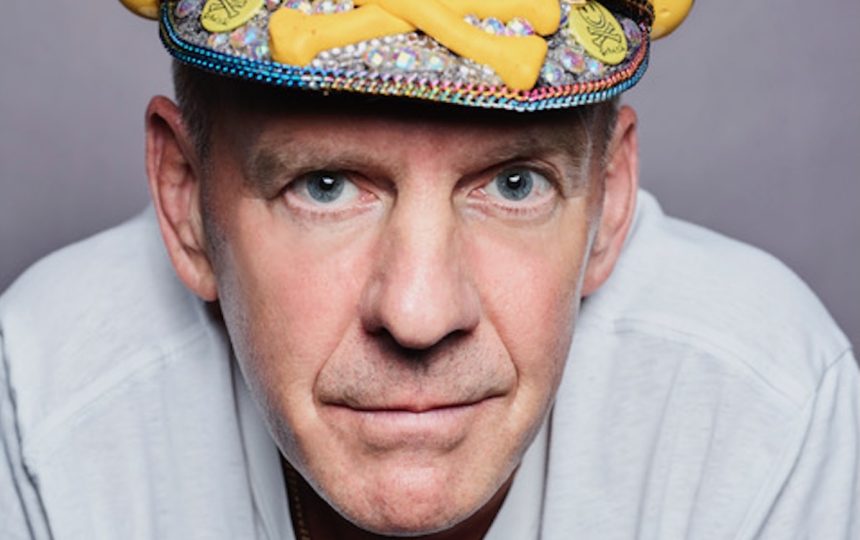
Norman Cook has lived long enough inside dance music to watch it become something else entirely.
Before billion-dollar EDM festivals, VIP risers and oceans of phones held aloft at every drop, there was the thrill of something looser and less predictable. There was a time when dance music still felt dangerous, when DJs weren’t treated like luxury brands and nights out weren’t measured by how well they played on social media. Cook, better known as Fatboy Slim, came up in that world. Decades later, he’s still working in the one that replaced it.
That perspective is part of what makes him such an enduring figure. Fatboy Slim is not just one of dance music’s most recognizable names, or the artist behind era-defining tracks like “Praise You,” “Right Here, Right Now” and “The Rockafeller Skank.” He is also one of its clearest witnesses: someone who can talk about the genre’s past, present and future without sounding trapped in any one of them.
Speaking from his home in Brighton, England, ahead of a Dallas stop and another return to Coachella, Cook sounds reflective but hardly cynical. He understands what dance music has gained as it has grown, even if he still misses some of what it has lost along the way.
“Coachella is like an institution now,” Cook says. “It’s sort of become like the American Glastonbury, and it’s kind of the benchmark for festivals.”
He says that with admiration, but also with the knowing tone of someone who has watched a counterculture harden into an industry. In his view, Coachella’s evolution mirrors the path dance music itself has taken over the last few decades: bigger, more polished, more commercial and, inevitably, a little less wild.
“It’s become bigger, but it’s also become more corporate,” he says. “It’s the same as everything. It’s the same as the whole dance scene. It’s bigger, so it’s more commercial. But because it’s bigger, there’s more room, and there’s more money, and there’s more jobs, and there’s more work for us DJs. But it hasn’t quite got the same edge that it had all those years ago, when what we were doing felt dangerous and different and naughty.”
Cook doesn’t frame that change as a tragedy so much as a tradeoff. The underground always gets absorbed eventually. Scenes that begin as unruly and intimate tend to become marketable, then mainstream.
Still, Cook is not interested in giving some tired speech about how everything was better back then. For one thing, he’s still here. More important, he still sounds excited by the core of the work.
“As someone who has been around for a long, long time, it’s great because I’m still here,” he says. “There’s still a job for me. There’s still an audience for me. So I’m not going to complain.”
That balance runs through the way he talks about DJing. At a time when festival sets can feel engineered for highlight reels, he still believes in the slower, less flashy pleasures of a proper dance floor. That is part of why his upcoming Coachella appearance feels notable. With the festival’s Quasar stage offering longer sets designed for dance music rather than compressed crossover spectacle, Cook sees room for something more organic.
“The good thing about playing a longer set is you kind of get to know the crowd, and they get to know you, and you can go more to interesting places,” he says. “If you turn up at a festival and you’ve got like an hour, hour and 15 minutes, all you’re going to do is play the big hits and try to make as big a splash in as short a time as possible.”
That approach may satisfy a modern festival audience trained to expect constant peaks, but it is not the version of DJing Cook finds most rewarding.
“For me, the true spirit of DJing is that you go on a journey with the crowd rather than you stand there and perform at them,” he says.
Thrill of Discovery
That distinction says a lot about what still motivates him. Fatboy Slim may be a star, but he still talks like a selector. He lights up less when discussing his own legacy than when describing the thrill of discovering music and sharing it in real time. Asked how he keeps himself from getting bored while playing so many shows year after year, Cook barely mentions his own catalog.
“The beauty of being a DJ is you don’t have to play your own records,” he says. “There’s this whole world of other people’s records that you can have fun with.”
He talks about spending the week digging through tracks online, listening to submissions and searching for the song that no one else has found yet. The excitement is not in repeating old successes but in chasing new sparks.
“When I hear a tune that I love, I just can’t wait to share it with other people,” he says. “That is the thrill finding a tune, especially when you find a tune that no one else has found, and then you drop it in your set and everyone’s going, ‘Ooh, what’s this?’”
That curiosity has probably done as much as anything to preserve his relevance. Plenty of dance music legends survive by becoming monuments to their own greatest hits. Cook, by contrast, still sounds like someone who is genuinely animated by the act of discovery.
For all his openness to the new, he remains deeply protective of the conditions that make dance music meaningful in the first place. If there is one thing that frustrates him, it is the transformation of dance floors into status theaters. They’ve become places where people go not to lose themselves in the music, but to document themselves being near it.
There are, he says, parts of the modern American dance world that have drifted far from the genre’s communal roots.
“There are aspects of it, especially in the American EDM scene, that has lost some of the spirit and the love of it,” Cook says.
But he still sees venues and parties that preserve the older ethos as spaces where the point is not access or optics, but surrender.
“There’s still outposts of that old school, pure love of the music,” he says, pointing to rooms like SILO. “Not the love of wanting to be on a VIP table and drink the most expensive vodka in the world. That innocent love of the feeling of community where you’re in the middle of a crowd and you’re all dancing, you become one organism.”
What he values most about dance music is not merely the sound, but the temporary social world it creates. At its best, a great set dissolves audiences into one another. It replaces self-consciousness with rhythm, hierarchy with momentum.
That is also why he puts so much stock in the small details that shape a room’s energy. One of the clearest signs of a good club, he says, is a no phones policy on the dance floor.
When so much of live music is filtered through screens, that stance can sound almost radical. But for Cook, it is really just common sense. Dance music, he suggests, only fully works when people are willing to participate in it rather than merely observe themselves participating in it.
“It’s funny that you have to remind yourself that dance music is the most fun when you actually dance to it,” he says.
It is a simple line, but it lands as both joke and diagnosis. So much of contemporary nightlife now seems built around distancing people from the very thing they came for: the release of being in motion, in public, among strangers, without worrying about how it looks. Cook has spent enough time inside clubs to know how fragile that feeling can be. He also knows how powerful it is when it appears.
For all the scale of his career, he keeps returning not to sales figures or milestones but to moments: a crowd locked in, a room tipping over into euphoria, a couple disappearing into each other in the middle of the floor.
“It’s an honor and a privilege to watch people having a good night out,” he says. “When I see a couple lost on the dance floor, snogging each other’s faces off, it’s like, you’re having the time of your life, and it’s my honor and privilege to be providing the soundtrack while you do that.”
That may be the clearest explanation for why Fatboy Slim still matters. Not because he represents some frozen golden age, but because he still seems connected to the emotional center of the culture he helped build. He is not chasing dance music as lifestyle branding or content strategy. He is still chasing the temporary freedom that made it matter in the first place.
“I play my part, the crowd plays their part and the music plays its part,” he says. “Between the three of them, we create this moment. This feeling of escape from your everyday life or your everyday problems and this wonderful sense of freedom for a few hours.”
Fatboy Slim performs at 9 p.m. Friday, April 10, at SILO, 1340 Manufacturing St. Tickets start at $56.