There are electronic music festivals designed to overwhelm you.
Then there are festivals designed to take you somewhere.
Balance Croatia belongs firmly in the second category.
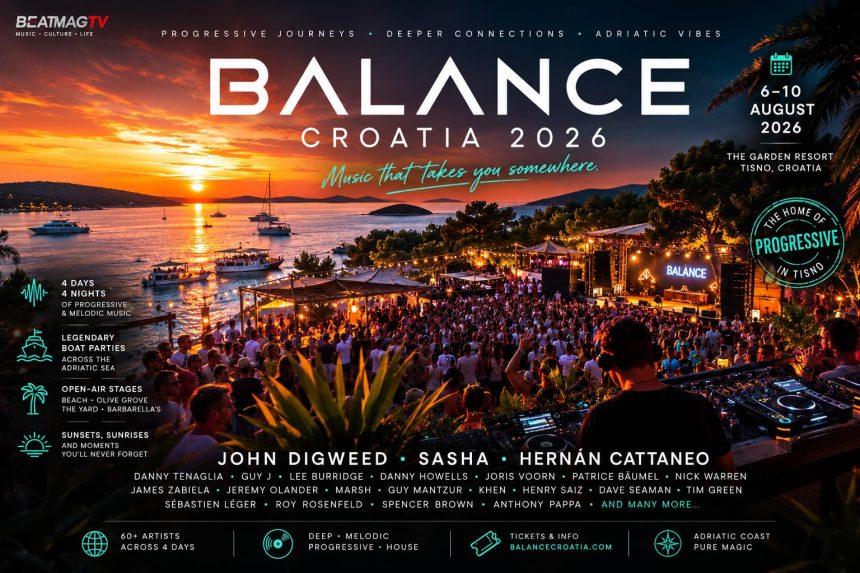
Returning to The Garden Resort in Tisno from 6 to 10 August 2026, the festival brings together more than 60 artists for four days and four nights of progressive house, melodic techno, deep house and the kind of patient, emotionally charged electronic music that rarely receives enough space at larger events. The official programme promises open-air stages, boat parties, beachside sessions and music running from midday until early morning.
For anyone who has spent decades around underground electronic music, the word progressive carries a deeper meaning than it sometimes does today.
It was never simply a genre.
It was an approach.
A belief that a DJ set should not be a collection of disconnected peaks, but a journey with tension, movement, patience and release. The great progressive DJs understood that the most powerful moment of the night often arrived because of everything that happened during the previous two hours. They trusted the audience. They allowed records to breathe. They built slowly, carefully and emotionally.
Balance Croatia is built around that philosophy.
The festival is connected to Balance Music, the Australian label and compilation series that has documented progressive electronic music for roughly a quarter of a century. Across its history, Balance became associated with long-form musical storytelling and artists who understood the mix as something closer to cinema than radio. The festival translates that legacy into a physical environment: a coastline, a crowd and enough time for music to unfold properly.
That distinction matters.
In a period when many festival sets are becoming shorter, louder and increasingly obsessed with instant reaction, Balance offers a different rhythm. It asks the crowd to remain present. It rewards attention. It understands that depth cannot be rushed.
The 2026 lineup reflects that identity beautifully.
At its heart are three artists who have shaped progressive house across generations: John Digweed, Sasha and Hernán Cattaneo. Their names are familiar, but their importance should never be reduced to nostalgia. Each has spent decades proving that longevity in electronic music comes not from repeating the past, but from constantly refining how a story is told through sound.
Digweed remains a master of controlled intensity. His sets rarely reveal their destination too early. He builds pressure through subtle changes in rhythm and atmosphere until the room suddenly feels transformed.
Sasha has always carried a more emotional and cinematic quality, blending melody and technology without losing the human element.
Cattaneo, meanwhile, has perfected a deeply hypnotic style in which transitions seem almost invisible. His music does not force itself upon the audience. It draws people inward.
They are joined by an exceptionally strong supporting cast including Danny Tenaglia, Guy J, Lee Burridge, Danny Howells, Joris Voorn, Patrice Bäumel, Nick Warren, James Zabiela, Jeremy Olander, Marsh, Guy Mantzur, Khen, Henry Saiz, Dave Seaman, Anthony Pappa, Tim Green, Sébastien Léger, Roy Rosenfeld, Spencer Brown and many more. The full bill moves confidently between progressive house, deep melodic music and more adventurous electronic territory without losing its central identity.
This is not a random collection of fashionable names.
It feels curated.
That word is often overused, but here it is appropriate. The artists belong together because they understand pacing, atmosphere and narrative. Even when their individual sounds differ, they share a respect for the long arc of a set.
The setting could hardly be more suitable.
The Garden Resort has become one of the most important festival venues on the Adriatic, but Balance uses it in a particularly natural way. The Beach Stage allows the music to begin under daylight, when the sea and surrounding hills soften the edges of even the deepest records. The Olive Grove provides a more intimate, shaded environment, while The Yard offers a central gathering point where the energy can rise as afternoon becomes night. Boat parties travel along the coastline, turning the Adriatic itself into another dancefloor.
Then there is Barbarella’s Discotheque.
The opening afterparty on Thursday, 6 August, is set to feature John Digweed and Danny Howells, two selectors whose understanding of extended club music makes them ideal for that legendary open-air space. Barbarella’s has never needed decoration to create atmosphere. The darkness, the trees, the stars and a properly built sound system are enough.
That night may become one of the defining moments of the festival.
Not because it will necessarily be the loudest.
Because it may be the deepest.
There is something almost defiant about a festival like Balance Croatia existing in 2026.
It represents a style of club culture that refuses to hurry. It rejects the idea that every record must produce an immediate explosion. It gives experienced DJs enough time to communicate properly, and it brings together an audience capable of listening as well as dancing.
That audience is essential.
Progressive music has always required trust between the person behind the decks and the people on the floor. The DJ must believe the crowd will follow. The crowd must believe the journey is leading somewhere worth reaching.
When that trust appears, something rare happens.
Time disappears.
A three-hour set begins to feel like twenty minutes. A transition becomes more powerful than a drop. A melody arrives at exactly the right moment and suddenly connects a thousand private memories across one shared dancefloor.
These are the moments Balance Croatia appears designed to create.
Tisno has hosted many styles of electronic music over the years, from bass and dub to house, techno and disco. Yet progressive house may be uniquely suited to this landscape. Its long blends and emotional horizons mirror the environment itself: the slow movement of the sea, the changing light and the transition from burning afternoon to deep Mediterranean night.
The music does not compete with the setting.
It becomes part of it.
After more than thirty years inside electronic music culture, it becomes increasingly easy to recognise events built around trends and events built around belief.
Balance Croatia feels like the latter.
It believes in musical patience.
It believes in experienced selectors.
It believes that a festival can be intimate without being small in ambition.
Most importantly, it believes that a dancefloor can still be a place of genuine emotional discovery.
That may not sound revolutionary.
But in 2026, perhaps it is.
Balance Croatia is not promising the biggest spectacle on the Adriatic.
It is promising something far more difficult to manufacture:
A journey worth remembering.