
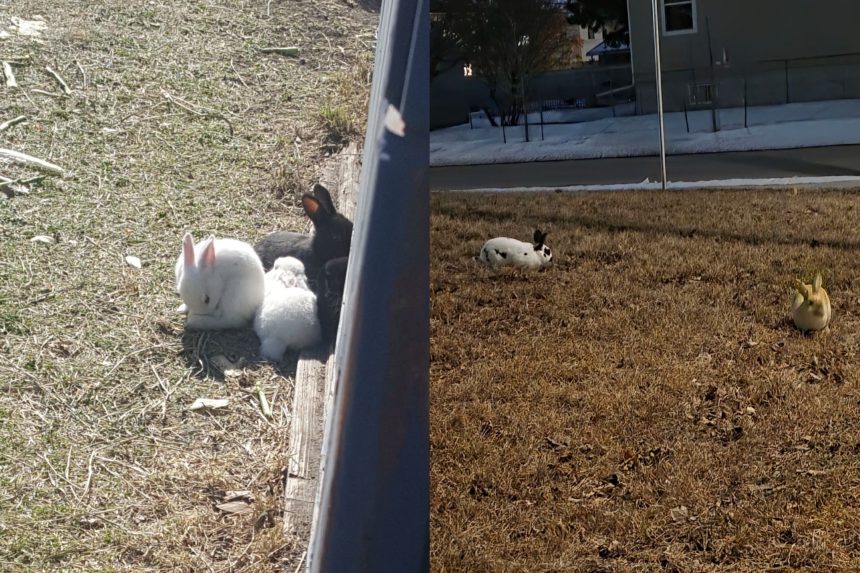
A feral domestic rabbit population is quietly growing in a north Edmonton neighbourhood, and residents say they’ve been left to manage the problem on their own.
What started as a couple of abandoned pets is growing into a larger issue, with residents in the Calder community worried the situation could spiral out of control if nothing is done.
“It’s been a major problem with few willing to take any responsibility for it,” said Leah Scheelar, a Calder resident who, along with a few neighbours, has been attempting to manage the population themselves.
Scheelar says the issue dates back to between summer and Fall 2024, when domestic rabbits were first spotted after being released in the area. By Spring 2025, residents began noticing baby rabbits, indicating the animals had survived the winter and were reproducing.
Leah Scheelar
“I’m expecting whatever offspring we didn’t catch last year to generate new litters this spring again. I know there’s at least one brown one, one black one and one white at large still. No clue of the genders, but odds are it’s not three of the same.”
With no formal support, Leah began organizing efforts herself, reaching out to rescues and community members to try to prevent what she described as “a slow-motion explosion” of the rabbit population.
“I was very concerned that 14 rabbits were going to quickly turn into 300 and then 3,000. So I started trying to catch them and recruit others to help.”
Through those efforts, she connected with others willing to help. One couple managed to catch two rabbits using a pool skimmer, while Scheelar says she caught four using an old fishing net. Some rabbits were kept as pets, while others were rehomed.
But it became harder to catch the rabbits after neighbours became curious about the sightings and children began chasing them. The situation worsened when a nearby business removed the shelter the rabbits had been using, causing them to scatter across a wider area.
Sightings have since been reported on and off, primarily in the western half of the neighbourhood. Scheelar reported seeing more loose domestic rabbits in the area as recently as Tuesday evening.

Leah Scheelar
Leah says the goal has always been to safely capture and rehome the animals before the population grows further and the rabbits suffer.
“I want to prevent the animals suffering diseases, predation by cats, coyotes, birds of prey, everyone’s gardens getting eaten, and an explosion of invasive species,” she said. “Basically, everything that comes from the irresponsibility of the two people who released them.”
Despite concerns, Scheelar said attempts to get help through official channels led nowhere.
“The city didn’t want to have anything to do with it. They said to call animal control. They didn’t want to deal with it,” she said, adding she had also contacted local wildlife and pet rescues, who also told her they couldn’t help.
Daily Hive reached out to the City of Edmonton, which confirmed that animal control responded to complaints in 2025 but says it did not find any groups of feral or distressed domestic rabbits. The city noted that rabbits are not regulated pests and it does not actively manage their population.
Scheelar says she knows who released the rabbits and wants to see them face consequences.
According to the Alberta Invasive Species Council, releasing a pet of any kind into the wild is illegal in Alberta and can be subject to a fine. Feral rabbits can have a detrimental impact on native plants by overgrazing, leading to soil erosion and biodiversity loss.
They can also carry diseases such as tularemia and myxomatosis, which threaten other wildlife and domestic pets. Alberta populations have faced outbreaks of rabbit hemorrhagic disease (RHD), a highly lethal and contagious virus that could spread to native rabbit and hare species.
RHD wiped out a feral rabbit colony in northwest Edmonton in September 2021. The virus was detected in three rabbits around the Holy Cross Cemetery, and by the end of the month, roughly 50 had either died or disappeared.