
Listen to this article
Estimated 4 minutes
The audio version of this article is generated by AI-based technology. Mispronunciations can occur. We are working with our partners to continually review and improve the results.
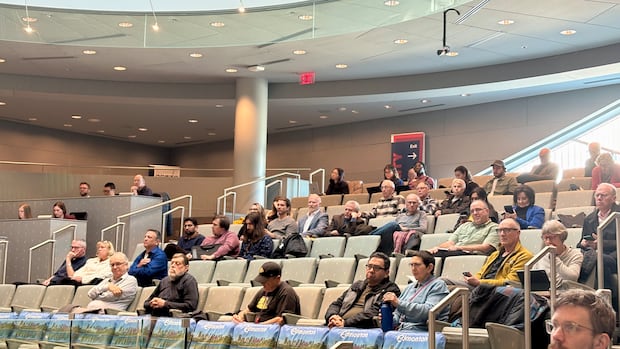
Edmonton’s urban planning committee heard arguments from citizens on Monday both for and against rolling back some of the city’s infill rules.
The feedback came as city administration recommends capping mid-block infill developments at six units instead of eight. But committee members also heard from people on both sides of the debate that they believe hard unit caps aren’t the answer.
“A big Lego block with six units inside is the same as a big Lego block with eight units inside,” John Soltice said.
“It is the size of the building that is the elephant in the room.”
He said he was surprised changes to height allowance weren’t among the recommendations made by city staff.
Jacob Dawang with the housing advocacy group Grow Together Edmonton said he thinks city council should stay the course, but also said he believes unit caps are not the right way of framing things.
“Let’s not talk about how many people or the living arrangement of the inside of a home,” he said. “Let’s just talk about how it looks from the outside.”

Siegfried Kirchner expressed concern about the height of some infill projects. The Edmontonian said his solar panels were shaded by an infill unit that went in next door.
“There is so much land in the city that our beautiful, old, mature, single-family neighbourhoods need to be protected from these towering monstrosities,” he said.
Coun. Michael Janz told reporters that when someone puts solar panels up on their property, they can never know what their neighbour will do.
“They may plant a tree, they may do something else,” he said. “And at the end of the day, we as the city have to be concerned about the housing shortage.”
The loudest voices
Several speakers asked questions about how accessible council and committee debates are for younger people, those from underrepresented groups or those who can’t afford to take a vacation day to attend.
Cherie Tellier-Klassen with the Women’s Advisory Voice of Edmonton noted that the city did not have time to do a gender-based analysis on the proposed changes.
“We have a lot of the loudest voices,” she said. “The most privileged voices are the folks that tend to speak up at council.
Tellier-Klassen suggested she would like to see more racialized women at such debates.

Other speakers made the argument that council received a mandate via the fall election to continue as planned on infill, with incumbent councillors overwhelmingly voted back in.
“To be blunt: these proposed amendments are a waste of time,” Karl Parkinson said.
“I ask the committee to resist the urge to fix what isn’t broken.”
One of the reports presented by administration notes that last year the city approved 272 row housing permits for mid-block sites in the small scale residential zone, up from 86 sites the year before.
Private tree bylaw
City administration was also asked to come up with recommendations to support the maintenance and retention of trees on private property amid increasing development.
“A private tree bylaw is not recommended,” the report says. “Administration is focusing on improving landscape compliance by expanding the landscape securities program and exploring opportunities to incentivize and regulate resilient landscaping practices.”
Lindsey Butterfield, vice-president of government relations and policy with real estate group BILD Edmonton Metro, said several city councils have shot down the idea already. It lost on a tie vote a few years ago.
“We do not support the concept of a private tree bylaw coming to council for the 14th time in a decade,” she said.
Kristine Kowalchuk, president of the Edmonton River Valley Conservation Coalition, said cities with private tree bylaws such as Toronto, Montreal, Ottawa and Victoria have more dense tree canopies.
“Edmonton’s numbers are starkly lower,” she said.
“We’re going in the opposite direction as we’re losing so many trees on private property.”
Kowalchuk said tree bylaws aren’t an impediment to density, but do ensure good design.
The committee meeting will continue Tuesday before making any decisions. Any changes would have to also go to a public hearing in April.


![[EVENT REVIEW] My First Ultra: A Deep Dive into Ultra Music Festival Miami 2026](https://beatmag.tv/wp-content/uploads/2026/04/ULTRA2026_0328_185228-PZA09942_PIKZELZ-150x150.jpg "[EVENT REVIEW] My First Ultra: A Deep Dive into Ultra Music Festival Miami 2026")