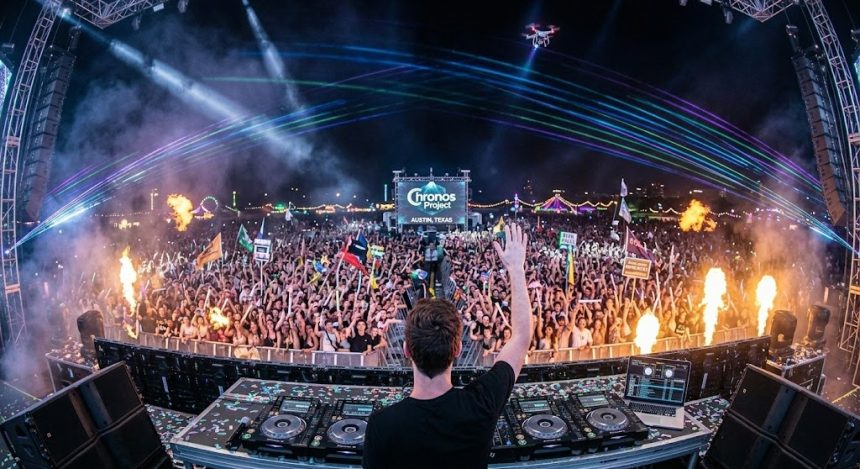
Three months into 2026, the picture is already clear enough to call.
The year opened with the Splice and MIDiA Research Sounds of 2026 report dropping a data bomb — Afro house grew 778% year-over-year on Splice alone, jumping house music from the fifth most-downloaded genre to the second in a single cycle. Tomorrowland announced Calvin Harris’s Belgium debut alongside a multi-year narrative framework that will run through Thailand and Brazil. Ultra Miami just wrapped its 26th edition with John Summit closing Sunday’s main stage. EDC Las Vegas sold every ticket before April. And the cost of attending an average three-day US festival has crossed $425, creating real friction between the industry’s commercial ambitions and the economic reality of its audience.
This is a mid-year state-of-the-union. Not predictions made in December before anything happened — observations made now, in March 2026, with real data behind them. Here is what is actually occurring in electronic dance music.
1. Afro House Is the Undeniable Sound of This Year
The numbers are not ambiguous. Afro house recorded 778% growth in downloads on Splice in 2025 — from 760,000 downloads in 2024 to more than 6.6 million, accounting for nearly 70% of all house music growth in the process. MIDiA Research named it the Sound of the Year in the Sounds of 2026 report, and the data supports the designation: 1.3 million searches, global traction across North America, Europe, Asia, and the WANA region, and organic instrumentation that has struck a nerve in an era saturated with algorithmic production. When Beatportal tracked the genre across the platform, the pattern was consistent — Afro house was climbing everywhere simultaneously, not just in South Africa or Johannesburg where the form originated.
What makes the growth meaningful rather than merely viral is its source. Afro house is organically instrumental — rooted in percussion, soulful vocals, and rhythms developed over decades in African club culture before being discovered by global producers on sample platforms. Pioneered by artists like Vinny Da Vinci, DJ Christos, and Black Coffee, the genre has been building since the 1990s and is now reaching a mainstream that is finally paying attention. Vanco’s “Ma Tnsani (Yalla Habibi)” — the most Shazamed track in Ibiza during the 2025 season, 80 million streams, a Tiësto remix — is the clearest illustration of how far outside South Africa its gravitational pull now extends.
The implications for producers are direct. LANDR reported an eightfold increase in African music-inspired sample downloads in 2024-2025. Istanbul emerged as Splice’s fastest-growing major city in this category. The production community is moving faster than the mainstream, and the mainstream is catching up.
2. The BPM War Is Real — Faster Is Winning
The Sounds of 2026 report’s secondary finding is as significant as its headline: speed garage, hard techno, jump-up drum & bass, and hard dance all posted triple-digit growth in the same cycle that Afro house exploded. These genres sit on opposite ends of the sonic spectrum — Afro house is organic, hypnotic, warm; speed garage and hard techno are relentless, industrial, physically demanding — but both are growing simultaneously.
The shared driver is a production community moving away from midtempo compositions toward anything that crosses the 140 BPM threshold. MIDiA’s Mark Mulligan described the shift as “two parallel demands coexisting: slow, hypnotic rhythms or high-energy release.” NGHTMRE articulated it more directly at the end of 2025: “Drum and bass is in for 2026.” His own album, MINDFULL, leaned into the genre; so did the festival bookings that followed.
The practical consequences are visible across the 2026 festival season. Red Rocks hosted WORSHIP’s first-ever headline drum & bass show, which sold out. Tomorrowland’s new Afro-house stage launched at the same event that booked Sara Landry and I Hate Models for Mainstage slots. Hard techno, once confined to warehouse nights in Berlin, is closing main stages at Ultra. NOVAH — the Belgian hard techno artist who played 168 shows worldwide in 2025 and released “Papi” as a global anthem — is making her Mainstage debut at Tomorrowland Belgium in July. The 140+ BPM tide is washing into spaces that ten years ago would have been exclusively reserved for 128 BPM progressive house.
Speed garage deserves specific attention. The genre recorded 625% growth on Splice, driving over 3 million downloads. In the UK, where KETTAMA, Interplanetary Criminal, and Sammy Virji have built careers at the intersection of speed garage, hard house, and contemporary club sounds, the resurgence of UKG as an umbrella influence is affecting everything from Creamfields bookings to Beatport chart positions. Jungle, breakbeats, and bassline are all being lifted by the same tide.
3. Tech House Is Maturing Out of Its Moment — and Getting Better For It
Tech house still dominates festival mainstages and streaming charts. Dom Dolla, John Summit, FISHER, Chris Lake, and Mau P are among the most-booked artists in the world right now, and tech house’s grip on the 2026 festival calendar is structural rather than trend-dependent. The genre isn’t leaving. But something is changing in how it’s being made and received.
The Sounds of 2026 data shows a saturation signal: tropical house — a softer, less location-specific house variant — dropped 14% in downloads while Afro house surged. Searches for regional identity are growing; searches for generic “festival house crossover sounds” are fading. The IQSounds tech house report for 2026 noted that “generic festival house crossover sounds are fading out unless they are reshaped with more grit, swing, and character.” Detail work — shuffle, transient shape, bass texture, vocal timing — now carries as much weight as the obvious hook.
What this means for the genre in practice: the producers winning in 2026 are the ones who treat tech house as a delivery mechanism for specific ideas rather than as a default setting. John Summit’s Ctrl Escape (April 2026) is being watched as a bellwether — if it represents a genuine evolution of his sound rather than more of the same, the wider ecosystem tends to follow. The tech house artists who will define the back half of this decade are the ones who bring the detail work that the MIDiA/Splice data is signaling the community wants.
4. Drum & Bass Is Finally Crossing the Atlantic
DnB has headlined UK festivals for decades. It has sold out Red Rocks. It appears on Coachella and Lollapalooza bills. But it has historically been programmed in secondary positions at American festivals, treated as a specialty genre rather than a mainstage-ready force.
2026 is breaking that pattern. Sub Focus, Chase & Status, Hedex, and A Little Sound are all appearing at US festivals at billing levels that would have been impossible five years ago. EDM Identity’s end-of-year assessment identified DnB as “one of the hottest and most in-demand genres” among American ravers. Wax Motif and others have publicly flagged faster tempos as the direction of 2026 club culture. The genre’s natural energy — faster than tech house, physically more demanding than melodic techno, with a structural complexity that rewards serious listening — is connecting with an American festival audience that has been primed by years of bass music and hard dance.
The crossover isn’t just happening at festivals. WORSHIP’s sold-out Red Rocks debut demonstrated that DnB can fill the kind of amphitheater shows that were previously the exclusive domain of house and techno. Chase & Status performed a b2b slot at Tomorrowland’s mainstage — confirmation from the genre’s most visible institution that DnB deserves the same square footage as progressive house.
5. Artist-Led Festivals Are Challenging the Mega-Festival Model
The Experts Only Festival at Randall’s Island sold out at 50,000 fans in its first year. Electric Forest sells out annually. Lost Lands has 9 editions of its own. GRiZ, Excision, and John Summit now produce festivals around their own creative visions and fan communities, and those events are competing directly with EDC and Ultra for fan budget and calendar space.
The tension this creates for mega-festivals is structural. When an attendee has $1,500 to spend on live events this year, the choice between EDC Las Vegas (complete spectacle, 200+ artists, no specific artistic vision) and a smaller artist-led event (one creator’s vision executed with total consistency, guaranteed aesthetic identity) is no longer obvious. The ultra-large events win on production scale. The artist-led events win on intentionality.
Tomorrowland’s response to this tension is instructive: CONSCIENCIA — the 2026 narrative framework connecting Belgium, Thailand, and Brazil — is a direct attempt to give the mega-festival the emotional coherence that artist-led events deliver by default. The six emotional pillars, the multi-continent story arc, the new Afro-house stage, the Face 2 Face performance format — all of these are Tomorrowland trying to do what boutique events do naturally, at stadium scale. Whether it succeeds will tell us something important about the limits of the mega-festival form.
6. The Affordability Crisis Is Shaping Where People Go and What They Skip
The average three-day US festival ticket in 2026 costs $425. That’s the ticket alone. Add accommodation, travel, food, and festival costs, and a weekend at EDC Las Vegas or Ultra Miami runs $1,500 to $3,000 for most attendees — more for those flying from outside the region. EDM Identity’s year-end assessment captured this directly: “as costs for basic needs rise across the US, ravers have less expendable money to spend on live music.
The consequences are visible in ticket dynamics. EDC Las Vegas sold out — but EDC has 30 years of brand equity and a milestone anniversary that justified the spend for people who had never been. Other festivals without that specific gravity are competing harder for a pool of discretionary income that is genuinely shrinking in real terms. The Association of Independent Festivals reported 45 UK festivals canceled or postponed by mid-2024, with soaring operational costs and reduced ticket sales cited as primary drivers. That trend has not reversed.
The US-Europe price differential is creating new behavior. American fans are increasingly weighing a European festival trip — where tax-inclusive pricing, accessible public transit, and competitive festival markets keep per-day costs lower — against attending a US event at full price. Ultra Europe at €229 GA for three days in Split, where the Adriatic coast is literally the backdrop, is a genuinely competitive proposition against $479 for three days at Bayfront Park in Miami.
This creates pressure on US festivals to justify their pricing through experience quality rather than lineup alone. The festivals building entertainment ecosystems, art installations, wellness zones, and community programming are differentiating on grounds other than who’s headlining. The ones competing purely on headliner recognition are vulnerable to the math.
7. The Genre Boundaries Have Effectively Dissolved — “Micro Is the New Macro”
The Sounds of 2026 report’s most important structural observation: “mainstream culture is being replaced by highly diversified listening habits and the blurring of musical styles across genres and scenes.” MIDiA’s phrase “micro is the new macro” describes a landscape where no single genre trend dominates the way big room house defined 2012-2014 or tech house defined 2021-2023. Instead, dozens of micro-scenes are growing simultaneously, each supported by specific online communities and creator tools.
This fragmentation is visible on Beatport, where the Melodic House & Techno category now competes closely with Tech House and Techno for chart leadership while Afro House runs its own charts entirely. It’s visible on Splice, where speed garage (625% growth), hard techno, French house (102% search growth), and Latin house (87% search growth) are all surging in parallel with no single sound crowding out the others.
The practical implication for artists is that the path to relevance has diversified. You no longer need to make tech house to get placed in house playlists. You no longer need to book a Tomorrowland stage to have credibility with festival culture. Ninajirachi built a Coachella booking through what she calls “girl EDM” — an entirely self-defined category that borrowed from hyperpop, IDM, and maximalist production in ways that fit no existing genre box. KETTAMA’s Irish-Australian underground made its own category and exported it to London. Genre fluidity is not a trend to follow — it’s the operating condition.
8. Faith and the Dancefloor: The CEDM Movement Is Getting Serious
Buried in the middle of 2026’s trend map, but worth naming: Christian electronic dance music is experiencing the most credible moment in its history as a genre movement.
What used to be scattered SoundCloud uploads and church worship remixes has developed an actual infrastructure. AXIOM Label Group — positioning itself as the primary artist development home for Christian EDM — is building a roster that approaches the music from the production side first: Rave Jesus (the project of Detroit producer Topher Jones, whose secular career as King Topher generated support from Diplo, Tiësto, John Summit, and Kaskade), Jeremy James Whitaker (experimental electronica whose LP The Last One Standing generated genuine critical attention), Sydni Alexander (Christian pop vocalist whose “Deja Vu” gained traction after the HNG 10 remix found mainstream electronic playlist placement), and AndyG. The collaboration between Rave Jesus and AndyG — “Devil is a Liar,” released January 23 on Bring The Kingdom Records, catalogued on Beatport as Mainstage / Big Room at 140 BPM — is indistinguishable from secular festival anthems at the production level. That’s the whole point.
The cultural context matters here. Research from Beatportal identified dance/electronic music accounting for 45% of Coachella’s 2026 lineup — up 39% from the prior year — confirming that electronic music is more embedded in mainstream youth culture than at any point in its history. That same demographic skews significantly more religious than the previous generation of rave culture expected. EDM audiences in 2026 include millions of Christians who have been without music that speaks their values in their genre’s language. AXIOM Label Group’s bet is that serving that audience, at professional production standards, is both artistically meaningful and commercially viable.
It’s too early to call CEDM a mainstream trend. It remains a niche within a niche. But the difference from five years ago is production quality — and that difference is everything.
9. Asia Is Now a Pillar of the Global Festival Architecture
The Tomorrowland Thailand announcement — December 11-13, 2026 at Wisdom Valley in Pattaya, backed by a five-year agreement with the Thai government — is not just a new festival date. It is the formalization of a shift that has been building for a decade. Dance music’s global audience has long included hundreds of millions of Asian listeners who have had no local access to the production scale of European festivals. That gap is closing.
Sunburn in Mumbai draws 350,000+ across three days in December and has been doing so for over a decade, with production values that attendees regularly compare to Tomorrowland. Seoul became Splice’s largest international market by downloads. Istanbul is the fastest-growing major city for Afro house production. The WANA region (West Asia and North Africa) is driving meaningful genre development that flows back into European and American playlists.
What 2026 establishes is that the festival calendar is genuinely global rather than European-and-American with international satellites. Tomorrowland’s CONSCIENCIA narrative — threaded through Belgium in July and Thailand in December, culminating in Brazil in 2027 — is the most visible expression of that architecture, but it reflects a real structural shift. The artists who build touring strategies around only Western markets are leaving money and cultural relevance on the table.
10. The Scene Is Maturing — And That’s Good, Even When It Feels Like Loss
The underground has gone mainstream. The tickets are expensive. The mega-festivals have become tourism products. The algorithms know your taste before you do. Several insiders quoted by NIGHTMAG’s Electronic Music Forecast 2026 acknowledged the tension directly: “the scene needs to step away from mainstream platforms and actively support artist-centered alternatives.”
What’s easy to miss in that conversation is what maturation provides. The same EDM.com data showing dance/electronic at 45% of Coachella’s lineup is the data showing that millions of people who would never have encountered this music ten years ago are now inside its world. The Calvin Harris Tomorrowland debut isn’t a capitulation to pop — it’s the largest dance music festival recognizing that one of the genre’s most commercially dominant figures never performed there, and fixing that. The Afro house wave isn’t commercialization of African club culture — it’s African club culture reaching a global audience on its own terms because the structural conditions of streaming finally allowed it.
The scene is bigger, more expensive, more fragmented, and more global than at any previous moment. The underground that built it is still producing its best work — just at smaller venues, with smaller margins, and for audiences that find it through different channels than they used to. The dance music ecosystem of 2026 contains all of it simultaneously: Tomorrowland’s 400,000-person CONSCIENCIA narrative, Dekmantel’s 3,000-person curatorial intelligence, Rave Jesus’s 140 BPM mainstage production for a faith-based audience, KETTAMA’s post-punk speed garage that Fred again.. calls his favorite band in the world.
That coexistence is not contradiction. It is the genre functioning at the full range of its possibility. The scene is doing exactly what it’s supposed to do.
What to Watch for the Rest of 2026
Several things are still developing and will clarify over the next six months:
Whether Tomorrowland Thailand overdelivers or underwhelms. The first edition of any major festival in a new territory carries risk. December will tell us whether Tomorrowland’s production infrastructure is truly portable or whether Belgium’s magic is partly geography.
How John Summit’s second album lands. Ctrl Escape (April 2026) is the most-watched producer album release of the year in tech house. If it represents genuine artistic evolution, it will pull the wider genre in a new direction. If it consolidates his current position without expanding it, the genre’s next mutation will come from somewhere else.
Whether the affordability squeeze produces a festival shakeout. The macro trend is clear: costs are rising, discretionary income is strained, and the festivals competing purely on headliner recognition are most vulnerable. By December we’ll know which events maintained attendance and which didn’t.
How far DnB’s American moment extends. A sold-out Red Rocks is one thing. Multiple sold-out arena shows, or a US festival booking DnB as its actual headline, would be something different. The trajectory is set; the ceiling isn’t yet visible.
What AXIOM Label Group releases and how they land. The Christian EDM infrastructure is being built in real time. The back half of 2026 will show whether it can convert production quality into genuine audience development outside the faith community.
The genre has never been more fragmented, more global, more expensive, or more capable of producing excellent music simultaneously. That is where we are at mid-year 2026. Check back in December.
- 1. Afro House Is the Undeniable Sound of This Year
- 2. The BPM War Is Real — Faster Is Winning
- 3. Tech House Is Maturing Out of Its Moment — and Getting Better For It
- 4. Drum & Bass Is Finally Crossing the Atlantic
- 5. Artist-Led Festivals Are Challenging the Mega-Festival Model
- 6. The Affordability Crisis Is Shaping Where People Go and What They Skip
- 7. The Genre Boundaries Have Effectively Dissolved — “Micro Is the New Macro”
- 8. Faith and the Dancefloor: The CEDM Movement Is Getting Serious
- 9. Asia Is Now a Pillar of the Global Festival Architecture
- 10. The Scene Is Maturing — And That’s Good, Even When It Feels Like Loss
- What to Watch for the Rest of 2026