The Week in Technology: February 23-27, 2026
In a world where technology evolves at breakneck speed, the aerospace sector stands at the forefront of innovation. This week, significant breakthroughs have emerged, particularly focusing on electric vertical takeoff and landing (eVTOL) aircraft, uncrewed military applications, a new double-deck Blended Wing Body (BWB) design, and advancements in sustainable aviation fuel (SAF). Let’s dive into the exciting developments in these areas.
eVTOL Developments in Singapore
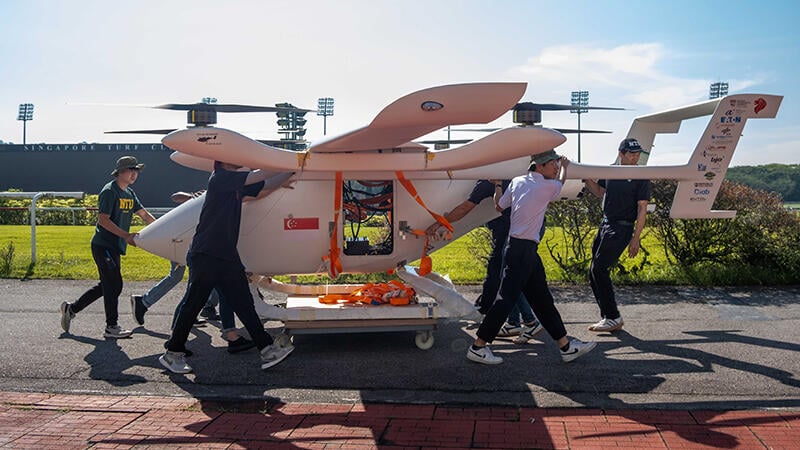
Singapore’s Nanyang Technological University (NTU) is making waves in the eVTOL arena. Their latest project involves a subscale electric vertical-takeoff-and-landing demonstrator, which is designed to pave the way for a full-scale, four-passenger vehicle anticipated to achieve certification by 2030. Recent tethered hover tests in Kranji, a suburban area in northwestern Singapore, have showcased promising results, marking an important milestone in the journey toward urban air mobility.
This innovative eVTOL model emphasizes efficiency and flexibility, aiming to redefine how we think about urban transportation. The ambition doesn’t just stop at passenger transport; the NTU team is also exploring the model’s potential applications in emergency services and logistics.
Missile-Launching Uncrewed X-Plane
In a significant stride towards military innovation, the development of a missile-launching uncrewed X-plane has captured attention. This advanced drone platform is intended to enhance aerial combat capabilities without risking pilot lives. Designed to carry and deploy missiles, this unmanned aircraft could shift the dynamics of modern warfare, enabling precise and swift attacks while minimizing human risk on the battlefield.
The technological framework supporting this development includes advanced automation systems, AI-driven target acquisition, and heightened stealth features, all poised to ensure operational effectiveness in a variety of combat scenarios. These advancements could redefine military strategies, emphasizing unmanned operations to reduce casualties and operational costs.
The Double-Deck Blended Wing Body (BWB) Concept
The aerospace industry is observing a rebirth of interest in Blended Wing Body configurations, particularly with the introduction of a double-deck design. This futuristic approach promises enhanced aerodynamic efficiency, reduced drag, and increased passenger capacity—all essential factors in modern commercial aviation.
Such a configuration not only improves fuel efficiency but also opens up new possibilities for cabin layouts, enhancing passenger experience. While still in the conceptual phases, the double-deck BWB model represents an exciting glimpse into the potential future of air travel, merging sustainability with enhanced performance.
Advances in Sustainable Aviation Fuel (SAF)
Sustainability continues to be a priority, with notable advancements in the production of Sustainable Aviation Fuel (SAF). Recent developments have focused on making SAF more accessible and affordable through innovative methods like co-electrolysis. This technique integrates renewable energy sources and CO2, significantly reducing the cost of SAF production and enhancing its viability in the aviation industry.
These advancements are crucial for meeting global climate goals, as the aviation sector looks to decrease its carbon footprint. By investing in cleaner fuel alternatives and innovative production methods, the industry can make substantial progress toward sustainable air travel.
In summary, the week of February 23-27, 2026, showcases a plethora of technological advancements across the aerospace field. From eVTOL aircraft spearheading urban mobility in Singapore to the military applications of uncrewed technology, alongside innovations in aircraft design and sustainable fuels, it’s clear that the aerospace industry is on the cusp of a transformative era. As these technologies continue to develop, they promise to reshape both how we travel and how we think about the future of aviation.