Monitoring Our Oceans: The Role of NOAA Fisheries in Sustainable Fisheries Management
NOAA Fisheries stands at the forefront of marine conservation, tasked with monitoring and managing over 460 fish stocks across an astonishing expanse of over 4 million square miles of U.S. ocean waters. This vast area, rich in marine biodiversity, holds not just ecological significance but also economic value. Striking a balance between sustaining these fisheries and supporting coastal economies is vital for the health of our oceans and the communities that depend on them.
Importance of Sustainable Fisheries
The health of fish stocks is not just a scientific concern; it influences livelihoods, coastal economies, and the seafood available on our tables. To guarantee sustainable harvesting of these stocks, NOAA Fisheries relies heavily on data-driven management decisions. These choices can significantly impact fishing seasons, total catch limits, and quotas—decisions that ripple through fishing communities and local businesses.
Accurate, reliable, and up-to-date data are essential. Recognizing this, NOAA Fisheries has embarked on a modernizing effort to enhance the collection, management, and application of oceanic data, making it an integral part of our national strategy.
Modernizing Data Collection Methods
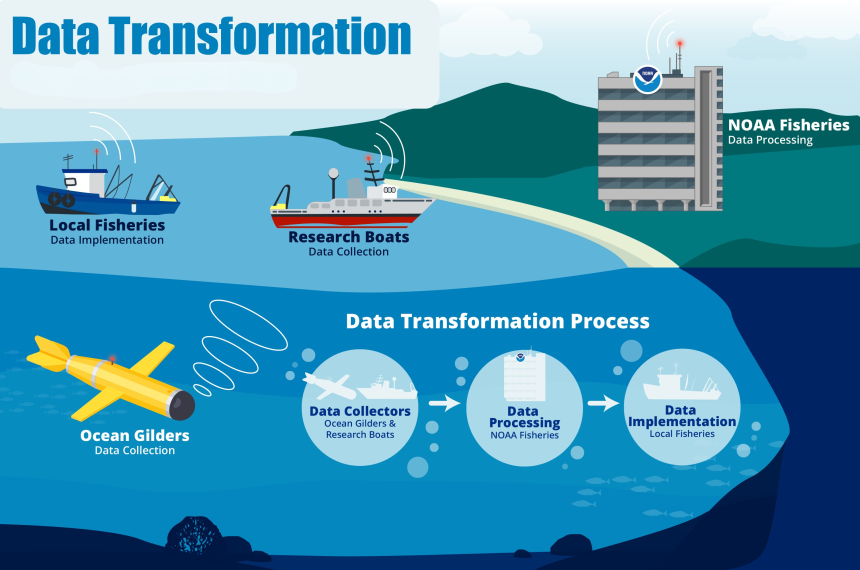
NOAA Fisheries’ modernization efforts are streamlined into two key areas: improving data gathering techniques and enhancing methods for analyzing, storing, and sharing acquired information.
Enhancing Data Gathering
Each observation collected at sea contributes crucial information regarding fish stock sizes, quantities, locations, and overall health. To refine stock assessments, NOAA aims to upgrade its data-gathering technologies. This means increasing both the volume and variety of observations made from platforms such as research vessels and innovative uncrewed systems.
Advanced technologies at play include:
- Uncrewed Systems: Utilizing ocean robots to collect data continuously without manned ships.
- Passive Acoustics: Sensing underwater activities by “listening” for marine life sounds.
- Active Acoustics: Employing sonar technology to estimate fish populations and map habitats.
- Optics: Utilizing advanced camera systems to observe species and their environments.
- Remote Sensing: Engaging satellites to monitor marine conditions and animal movements from space.
- Genomics (‘Omics’): Leveraging genetic technology to identify species from environmental water samples.
These tools pave the way for enhanced data collection in previously inaccessible regions, boosting our understanding of marine resource status while advancing analysis techniques, particularly in the rapidly evolving field of genomics.
Breakthroughs in Data Collection and Processing
Innovative technologies are transforming the way NOAA Fisheries collects and evaluates data. For instance, in the Gulf of America, new methods combining advanced video and acoustic imaging technology with Artificial Intelligence (AI) are revolutionizing the way red snapper and reef fish data get collected. These efforts allow for accurate abundance assessments even under poor visibility—critical for sustainable management practices.
In Alaska, NOAA scientists are harnessing the power of AI, machine learning, and computer vision to analyze fishery data more swiftly. This evolution aids in enhancing bycatch reduction methods, promoting smarter, more sustainable fishing practices.
Streamlining Data Analysis and Storage
Modernizing data collection is only half the battle; the next phase involves enhancing how this data is stored and understood. A secure and efficient processing system is crucial for managing the large influx of data NOAA Fisheries anticipates from new collection methods.
NOAA’s strategy aims at:
- Standardizing Data Assets: Ensuring data quality and consistency.
- Implementing Cloud-Based Solutions: Facilitating easier access to data and enabling agile responses to requests.
- Enhancing Data Management Processes: Streamlining workflows reduces both human effort and financial burdens.
Collaborations across the country, including partnerships with regional fishery management councils, ensure that data remains confidential yet widely accessible to those who stand to benefit from it.
Maximizing Efficiency in Data Systems
Specific initiatives focus on modernizing federal permitting and reporting systems, allowing users to manage quotas and obtain permits electronically. Efforts to streamline logbook reporting systems for commercial and for-hire fishermen further enhance data sharing capabilities and reduce costs.
The Future: Data Interpretation and Delivery
With upgraded technologies and robust data management practices, the interpretation and delivery of marine data will improve significantly. Access to comprehensive information about ocean health enables scientists nationwide to develop predictions and recommendations that foster better fisheries management.
By leveraging innovative systems, NOAA Fisheries will boost its capabilities in protecting endangered species, supporting aquaculture, and providing valuable insights to coastal communities reliant on marine resources. This evolution not only enhances scientific understanding but also ensures a sustainable future for American fisheries and the generations dependent on them.