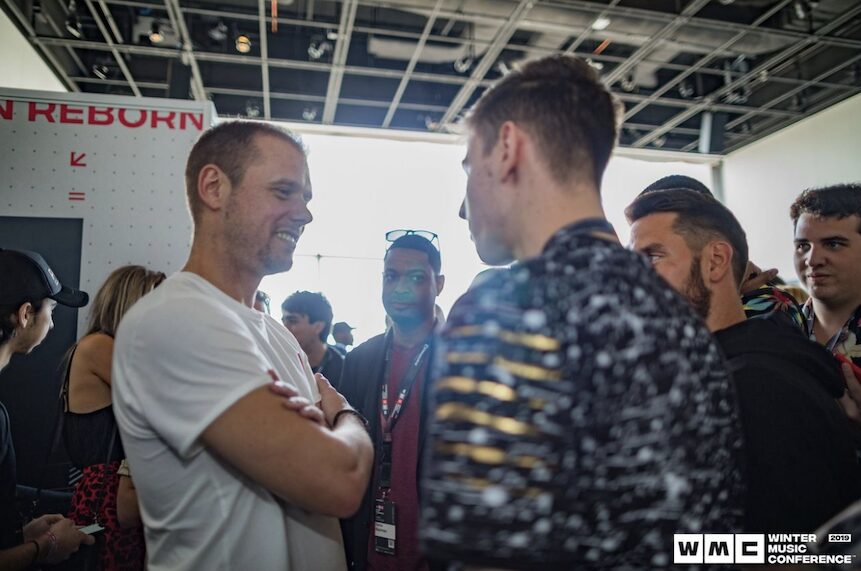
In its earliest years, the Miami Music Week wasn’t about massive crowds or viral moments—it was about business. But long before the citywide marathon of parties defined the week, there was a single event that brought the global dance music industry together in one place: Winter Music Conference (WMC).
DJs, label executives, radio programmers, and journalists traveled to Miami not just to celebrate the culture, but to shape it. “WMC in the beginning was all business, and the parties were really label showcases attended mostly by industry, press, artists, radio, etc.,” recalls conference director David Ireland.
As time progressed, the culture surrounding electronic music proliferated beyond the conference walls. Festivals burgeoned, ushering in a global fan culture that transformed Miami Music Week into a sprawling, decentralized network of events across the city. Promoters began orchestrating larger fan-driven parties, gradually dispersing the industry across dozens of showcases and activations. In this transformation, the once central conference faded from discussion.
David Ireland has closely observed this evolution over the years. With over three decades dedicated to music media and marketing—including a pivotal role in relaunching WMC under Ultra Music Festival—he has witnessed electronic music’s rise from an underground subculture to a global powerhouse. His return to guide the Winter Music Conference’s current chapter marks a renewed effort to reconnect the event with its original mission.
The task of rebuilding the conference isn’t a solo effort. Much of the operational backbone of WMC 2026 is supported by Nick Morgan, CEO of the international event production collective We Group. This year’s edition introduces innovative experiences, such as pool parties at the Kimpton EPIC Hotel. While this adds an exciting and fresh element for attendees, it also brings logistical challenges. “We’ve added pool parties on premise which brings its own unique challenges such as permitting and rigging 16 floors up from the lobby,” Morgan explains. However, he believes the payoff will be significant, as attendees enjoy events against a backdrop of the Miami River and downtown skyline.
With logistical challenges in tow, the leadership of the conference recognizes 2026 as an opportunity to redefine what Winter Music Conference offers the electronic music ecosystem. A pivotal element of this year’s programming is the focus on accessibility across varying levels within the industry. Ireland describes the conference as adopting a “two-track program.” One track is tailored for aspiring creators aiming to carve out careers in electronic music, while the other focuses on seasoned professionals already entrenched in the business.
This year’s conference also introduces an A&R Pop-Up Lounge, providing emerging artists and producers direct access to representatives from influential labels like Experts Only and Ultra Records. For established industry professionals, panels and discussions will delve into pressing topics, from artificial intelligence and audience fragmentation to effective marketing strategies and data management. “We always try to take the industry’s temperature and see what’s starting to bubble up,” Ireland states. This ensures attendees depart the conference equipped with actionable insights.
The physical environment of the conference heavily influences the dialogues and interactions that transpire. Rather than spreading programming across disconnected venues or relying heavily on a digital format, organizers are prioritizing the creation of a central hub where networking, panels, and social experiences converge. “For me, it’s really important that the hub truly feels like the hub,” Morgan emphasizes. Attendees will stay at the hotel, interact in communal areas, attend sessions, and find continuous events happening throughout the venue.
Looking to the future, Ireland emphasizes the importance of growing cautiously without compromising the essence of what makes the conference special. Organizers are already drafting a long-term plan with the city of Miami, aiming to expand thoughtfully while maintaining a center of gravity that ensures manageability and preserves the event’s unique atmosphere. “If you grow too much and spread everything out, you lose the magic,” he cautions.
Ultimately, the benchmark for success remains straightforward. “If you don’t leave WMC inspired and more in tune with the trends in our industry,” Ireland concludes, “then we are not doing our job.” As Miami Music Week grows more expansive, louder, and chaotic, Winter Music Conference strives to anchor itself in something deeper—offering a space where artists, executives, and newcomers can engage meaningfully, brainstorm ideas, and reflect on the future of electronic music before the spotlight shines on performances later that week.
The 2026 conference will take place from March 24 to 26 at the Kimpton EPIC Hotel in Downtown Miami. For more information on badges, programming, and events, visit the official WMC website. With its strategic move downtown and an enhanced mix of sessions and networking opportunities, the conference is positioning itself once again as a focal point amidst Miami Music Week’s usual tumult.