

Manolo Cabrera and Hugo Lara, who make up RØZ, packed the festival’s Sonora stage at full capacity for both consecutive weekends. Photo by Alejandro Tadeo/ CALÓ News
This year, RØZ, the up-and-coming DJ and producer duo in Mexico’s EDM scene, made a massive Coachella debut. Manolo Cabrera and Hugo Lara, who make up RØZ, packed the festival’s Sonora stage at full capacity for both consecutive weekends, leaving many wondering: Is Latinos’ impact underestimated in massive, multi-million dollar annual festivals like Coachella?
The short answer is yes, and RØZ’s performance is just one clear example of that.
At the festival, RØZ performed inside the Sonora Tent on April 11 and April 18, packing the venue, which fits approximately 1,000 people. Although the Sonora stage is designed to feel like a more intimate, air-conditioned indoor club venue and often features smaller punk, indie and Latino acts, RØZ, who has over 4.5 million monthly listeners, needed a bigger stage.
Multiple videos throughout social media, especially TikTok and Instagram, show fans waiting in long lines for RØZ, the majority of whom were unable to get inside the venue and others who settled to tune in to the livestream on YouTube and enjoyed the performance from outside.
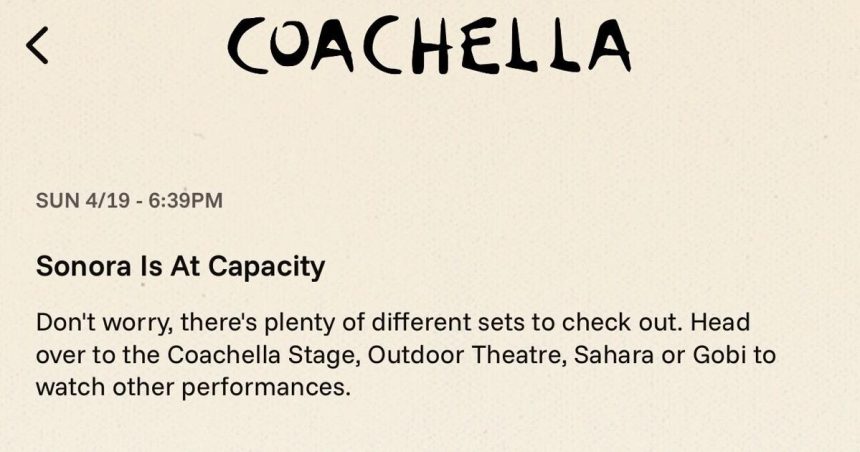
On Sunday, at 6:39 p.m., one minute before RØZ began their performance, Coachella sent a push notification via their app, stating that Sonora was at capacity. “Don’t worry, there are plenty of sets to check out,” the notification read.

Coachella’s push notification via their app, stating that Sonora was at capacity. Photo courtesy of Coachella.
This was the only other time, apart from the Yuma Stage on Friday afternoon, that Coachella announced a stage being completely full.
Despite local publications insinuating that one of the possibilities for the stage reaching full capacity on Sunday during RØZ was due to people seeking shade and air conditioning available at the Sonora stage, the truth is the Mexican duo had been an anticipated act for both weekends, and more importantly, Latinos will show up in support of Latino artists at festivals, despite knowing the artist or not.
Inside the venue, dozens of fans wore their Mexico jerseys and jerseys from other Latin American countries like Guatemala, El Salvador and Chile as they waited for RØZ to take the stage and perform some of their hits, including “Si mañana me muero,” “La vuelta” and “Ya no te quiero ver,” among others.
Cabrera and Lara met during high school and later collaborated informally until they were able to find their own sound and formed RØZ. In 2022, they began making waves in the electronic scene following the release of their debut single “What You Want.”
Today, the duo, based in Mexico City, is known for blending EDM and house with Latin sounds and in the last few years, they have transitioned to using and embracing Spanish language lyrics.
RØZ gained massive popularity in 2025 with hits like “Apaga la luz,” a track that features Peso Pluma and blends regional Mexican elements with house music.
They have also worked with other Latino artists, including Cloonee y El Bogueto, DannyLux, Tom y Collins and Natt Calma, as well as Yng Lvcas, whom they brought up as a special guest last weekend for the track “Flashes.”
During their 50-minute set, RØZ thanked their fans for filling the venue and said they were grateful to take on a stage like that of Coachella. “¡Que viva Mexico!” both Cabrera and Lara yelled before inviting the crowd to sing along to their closing song “Cora de Hielo,” which has more than 100 million streams on Spotify.
“Te amamos y te recordaremos por siempre. Arriba México y la gente Latina,” RØZ later wrote in an Instagram post.
In 2026, as Coachella features Karol G as the first Latina headliner, the conversation on the importance of the festival continuing to grow not only in Latino representation and talent but also in taking Latino audiences and fans more seriously continues.
Despite having a Latina headliner, Latin music at Coachella has been minimal.
According to publications including the New Industry Focus, House MusicU.S., and Booking Agent Info in 2026, EDM remains the largest share of genres for Coachella, followed by Indie and Rock.
Other prominent genres like hip-hop, R&B, soul, and Latin music declined this year, each accounting for only about 4% of the festival lineup.
Coachella may be dubbed the “influencer Olympics,” turning into a monetized and monopolized giant music machine, but Latinos have been part of the festival since its origins.
For starters, the first band to ever headline the festival in 1993 was Rage Against the Machine, whose lead singer was Zack de la Rocha, a Mexican American political artist who has sung about racism, imperialism and social justice through his music.
It is also Latinos who drive the Coachella Valley workforce, from local golf courses, agricultural fields and, of course, events like the Coachella Valley Music and Arts Festival.
Despite the Coachella Valley economy being heavily run on Latino labor, wage gaps continue. According to a University of Southern California report published this month, Latino workers in the Coachella Valley earn less than Latinos elsewhere in California and far less than non-Latinos across the state. Coachella Valley Latinos earn a median of $17.63 an hour, compared to $19.87 for Latinos statewide and $33.33 for non-Latino Californians.
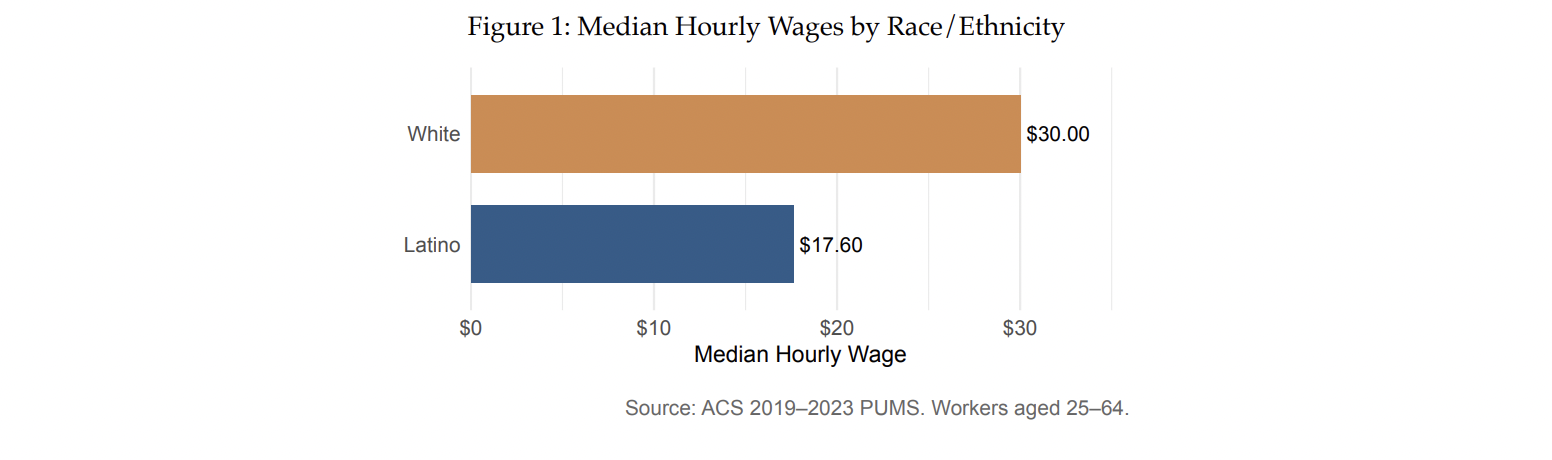

Latinos in the Coachella Valley face a 41% wage gap relative to white workers. Graph from the USC Center for Latinx and Latin American Studies report
For Valley Latinos, this means making 89 cents for every dollar earned by Latinos elsewhere and 53 cents for every dollar earned by non-Latinos statewide.
Despite the festival being made possible by Latinos and making millions in sales, it continues to be criticized for what many see as a dystopian, exclusive festival, which takes place in an area where over 39% of the population in the Eastern Coachella Valley lives below the poverty line.
RØZ’s packed Sonora stage scenario reminds many that even as the festival profits off Latino labor, promotes and markets Latino headliners, it has a long way to go when it comes to actively respecting Latino influence, both in and out of the festival grounds.