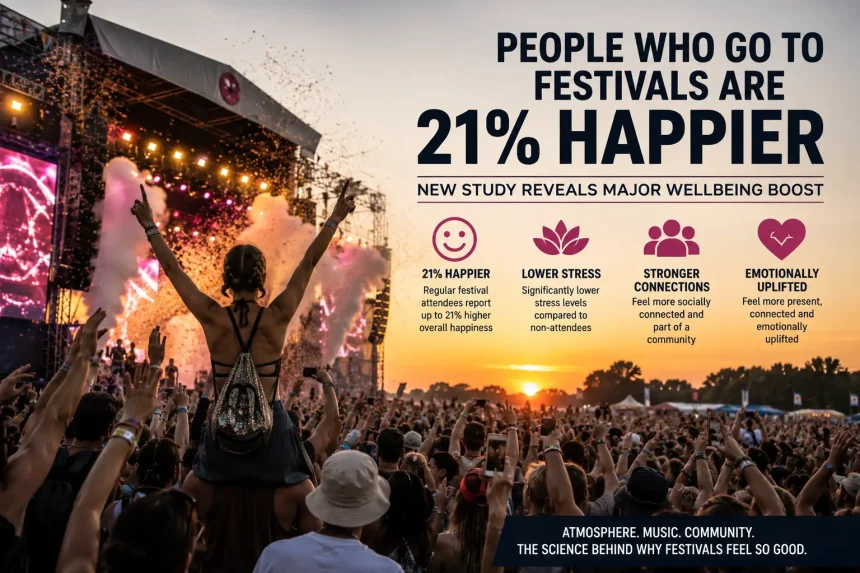
A new scientific study has found that people who regularly attend festivals and live music events report significantly higher levels of happiness and overall wellbeing compared to those who attend less frequently.
Conducted by behavioural scientist Patrick Fagan in partnership with O2, the research suggests that live music experiences can improve personal wellbeing by as much as 21%, offering measurable scientific support for something music fans have intuitively understood for years.
The study explored multiple emotional and psychological factors connected to live event attendance, including stress reduction, emotional uplift, social connection and general life satisfaction.
Participants who attended festivals and live music events more regularly consistently reported feeling happier, more connected and emotionally healthier overall.
Importantly, the findings go far beyond simply enjoying music itself.
According to the research, one of the strongest wellbeing effects came from the atmosphere surrounding festivals and shared live experiences. Participants described feeling more present, socially connected and emotionally engaged while attending events — particularly in environments where large groups of people collectively share music, movement and emotional energy together.
That collective aspect proved especially important.
The sense of belonging created inside festival environments emerged as one of the key drivers behind the reported wellbeing increase. In many cases, attendees associated festivals with emotional release, freedom from daily pressures and a temporary feeling of reconnection with both themselves and others.
The research arrives during a period where conversations surrounding mental health and emotional wellbeing have become increasingly central globally.
Over recent years, live music culture has often been discussed primarily through economic or entertainment perspectives. However, studies like this begin reframing festivals and live events as experiences with measurable psychological and physiological value as well.
That shift feels particularly relevant after the pandemic period, when festivals, clubs and live venues became some of the hardest-hit sectors worldwide.
During lockdowns and social restrictions, many people reported strong emotional effects connected to the disappearance of communal dancefloor experiences and collective nightlife spaces. The new festival wellbeing study now offers scientific evidence supporting the idea that those environments may play a far more important role in emotional regulation and social health than previously acknowledged.
Patrick Fagan’s research gives the live music industry something especially powerful:
hard data.
For years, artists, promoters and nightlife communities have argued that live music cannot truly be replaced through streaming, social media or digital experiences alone. While technology can distribute music globally, it cannot replicate the emotional intensity created when thousands of people experience rhythm, sound and movement together in physical space.
This study reinforces that argument directly.
It also strengthens a growing body of research exploring how music affects the nervous system, stress recovery and emotional processing. Recent studies connected to dance music environments have already shown that structured musical experiences can influence heart rate variability, emotional states and even physiological recovery after stress.
Festivals now appear to contribute to those same broader effects on human wellbeing.
As electronic music culture continues evolving beyond simple entertainment categories, research like this increasingly positions festivals and live events as meaningful social and emotional experiences with real psychological impact.
For millions of attendees worldwide, however, the findings may simply confirm what they already knew the moment they stepped onto a dancefloor:
music makes people feel better together.