Understanding “Live” in Electronic Music
Electronic music has transformed how we perceive live performances. At its core, the term “live” can be a slippery concept. It can sometimes be challenging to ascertain what constitutes a live electronic set, especially when instruments aren’t always visible to the audience. With a laptop capable of housing an entire band, recording studio, and even lighting effects, the artist’s role becomes more complex. Sounds crafted well in advance can be summoned at the touch of a button, creating an experience that blurs the lines between composition and performance. From the audience’s perspective, it often remains ambiguous whether the artist is reconstructing the music in real time or simply pressing play.
MUTEK: A Festival Exploration of Live Performance
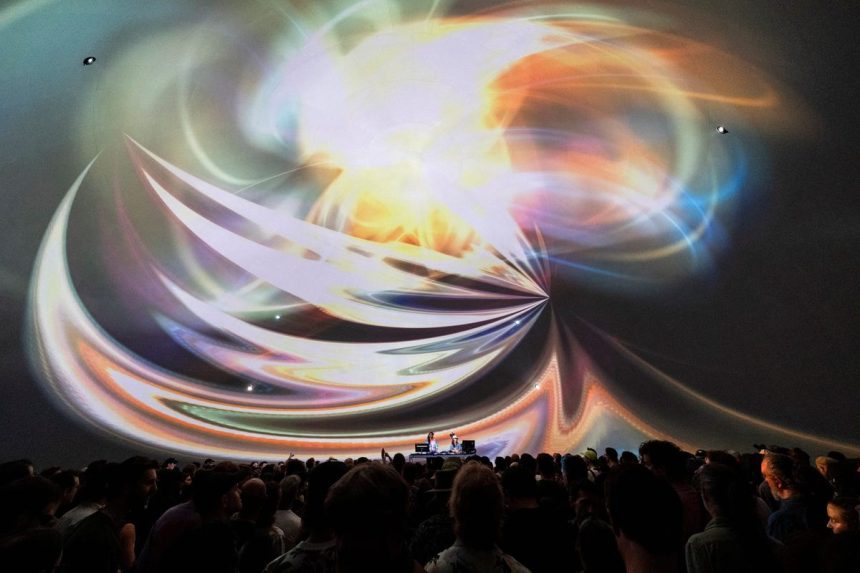
For over 25 years, MUTEK, the renowned Montreal-based festival, has embraced this ambiguity, turning it into a fascinating aspect of its identity. Founded in 2000 with the mission to showcase “live electronic music and real-time audiovisual performance,” MUTEK makes a vital distinction. The festival doesn’t merely treat electronic music as a series of recorded tracks that require a transfer to the stage. Instead, it views the stage as a dynamic laboratory where sound, visual artistry, technology, and human expression interact seamlessly and spontaneously.
The 27th edition of MUTEK, held from August 25 to 30, 2026, demonstrated just how expansive the festival’s interpretation of live performance has become. Over six days, MUTEK hosted 137 artists from 27 countries, showcasing 89 performances, four immersive films, and 62 premieres. Notably, more than half of the festival’s programming highlighted local Canadian talent. With a record-setting attendance of 102,591—including over 70,000 at its free outdoor stage—the festival’s appeal continues to grow, with a 42% increase over the previous year.
The Essence of a Live Electronic Performance
MUTEK’s philosophy underscores an essential question for audiences: Does a live set require the presence of an artist at that specific time and place? The answer reverberates with a resounding yes throughout the festival.
While DJing remains a fundamental part of MUTEK—with artists like Ben UFO pushing creative boundaries beyond standard mixing—the festival emphasizes that electronic performances can transcend linear track selection and sequencing. A truly live electronic set involves spontaneous decisions that have not yet been determined. Artists can embrace uncertainty; sequences may drift, machines might malfunction, and visuals can directly respond to the sound, introducing elements of surprise into the performance.
Unique Approaches from Diverse Artists
An exploration of some of the varied performances at this year’s edition reveals deep innovation. Montreal artist Honeydrip utilized contact microphones against her throat, capturing her breath’s vibrations and feeding them through an intricate system of electronics. This unconventional approach transformed what could have been a mere club set into a deeply physical and engaging musical experience.
In another remarkable showcase, Japan’s ELECTRONICOS FANTASTICOS! reinvented outdated technologies by assembling functional instruments from old CRT televisions, electric fans, and barcode scanners. Instead of serving as mere props, these repurposed devices became an orchestra of “electromagnetic punk,” rendering something both noisy and humorously alive.
Mexican producer Debit engaged the audience through a live AV performance, reconstructing materials from her album Desaceleradas while integrating various traditional instruments and multimedia elements. By fusing cumbia rebajada rhythms with archival footage of Monterrey’s Kolombia dance culture, her performance turned into an entirely new artistic object.
The Montreal duo Jump Source innovatively reworked their album Fold in real time rather than regurgitating it. Meanwhile, JakoJako engaged her audience with intricately sculpted modular sequences characterized by irregular timing, leaving ample room for unpredictability.
Venue as Instrument, An Artistic Canvas
In MUTEK’s universe, the venue itself often transforms into an instrument. The festival has showcased artists who utilize the environment to create a unique sound experience. This was embodied in the performance by Tristan Perich and organist James McVinnie, who intricately wove the sounds from the Maison symphonique’s pipe organ into a conversation with a sophisticated 100-speaker system.
Similarly, Kali Malone’s exploration of sustained tones and resonance through the pipe organ not only highlighted the historical significance of the instrument but also created an immersive sound landscape—demonstrating how space and sound coalesce in innovative performances.
Breaking Boundaries and Shaping Experience
The diversity of performances at MUTEK also emphasizes the potential for reimagining familiar sounds. From Princess Samsung’s laser-triggered sound experiments to Ida Toninato’s exploration of rhythm cycles with saxophone and electronic beats, the festival demonstrates how artists are redefining the boundaries of sonic experience in real time.
Each artist’s approach reminds us of the importance of interdisciplinary connections within electronic music, showcasing that the act of performance is rarely static but rather an evolving conversation between artists, technology, and the audience. In this transformation, MUTEK remains a trailblazer, a vibrant incubator for creativity, demanding audiences reevaluate their relationship with the concept of live music.