A new scientific study backed by AlphaTheta is changing the way electronic music culture understands the role of DJs on the dancefloor.
According to research designed by Emma Marshall, founder of MIM (Music and Movement is Medicine), and led by Professor Paul Dolan from the London School of Economics, DJs may be doing far more than simply selecting tracks and controlling crowd energy. The findings suggest that specific elements of a DJ set — including BPM, intensity and sound pressure — can directly influence heart rate, nervous system regulation and physiological recovery in real time.
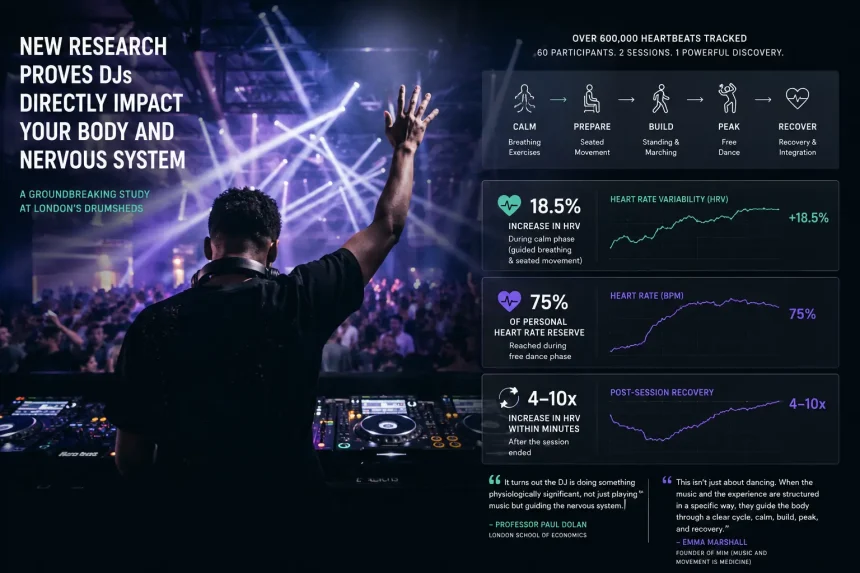
The study took place at London’s Drumsheds venue and tracked more than 600,000 heartbeats across two separate hour-long sessions involving approximately 60 participants each.
What researchers discovered paints a fascinating picture of the dancefloor as something much deeper than entertainment alone.
Participants moved through several carefully designed stages during the sessions, beginning with quiet listening exercises and guided breathing before progressing into seated movement, standing motion, marching and eventually unrestricted free dance. Throughout the process, researchers monitored cardiovascular responses and changes in heart rate variability (HRV), one of the key indicators used to measure stress regulation and nervous system balance.
The results showed surprisingly clear physiological shifts.
During the calmer opening phases involving breathing and seated movement, participants experienced an 18.5 percent increase in HRV — a sign that the body was entering a more regulated and resilient state associated with nervous system recovery and emotional stability.
As the sessions intensified and movement became more physical, heart rate rose significantly. During peak free dance phases, participants reached approximately 75 percent of their personal heart rate reserve, showing that dancing within properly structured musical environments can create cardiovascular responses similar to sustained athletic activity.
Perhaps most interesting was what happened afterward.
Within minutes of the session ending, participants experienced a rebound effect where HRV increased between four and ten times, suggesting that structured dance experiences may actively support post-stress nervous system recovery rather than simply overstimulating the body.
Researchers also discovered that DJs themselves played a measurable role in shaping these physiological changes.
During calmer moments of the session, BPM closely mirrored participant heart rate patterns, producing a correlation of r=0.85 in the first session. In simple terms, the body was synchronizing itself with the rhythm being presented.
As intensity increased, loudness and sound pressure became more influential than tempo alone. At peak dance moments, however, no single audio variable fully predicted participant heart rates anymore because the crowd had collectively generated its own internal cardiovascular momentum.
Professor Paul Dolan described the findings as evidence that DJs are effectively guiding the nervous system through different emotional and physiological states.
“It turns out the DJ is doing something physiologically significant, not just playing music but guiding the nervous system,” he explained.
Emma Marshall expanded on that idea further, emphasizing the structured emotional arc behind carefully designed dancefloor experiences.
“This isn’t just about dancing,” she said. “When the music and the experience are structured in a specific way, they guide the body through a clear cycle — calm, build, peak and recovery.”
The implications reach far beyond nightlife itself.
For decades, club culture has often been dismissed purely as escapism or hedonism, despite countless dancers describing emotional release, mental clarity and feelings of connection through shared musical experiences. This research begins providing measurable physiological evidence supporting what many people inside electronic music communities have intuitively understood for years:
music, rhythm and collective movement can fundamentally alter human emotional states.
The findings also arrive during a wider cultural shift where mental health, nervous system regulation and embodied healing practices are becoming increasingly important conversations globally.
In that context, the dancefloor starts looking less like passive entertainment and more like a modern ritual space — one where DJs function as emotional navigators shaping collective physical experiences through sound.
As electronic music culture continues evolving, studies like this may fundamentally change how society understands club environments, dance rituals and the real physiological power of music itself.