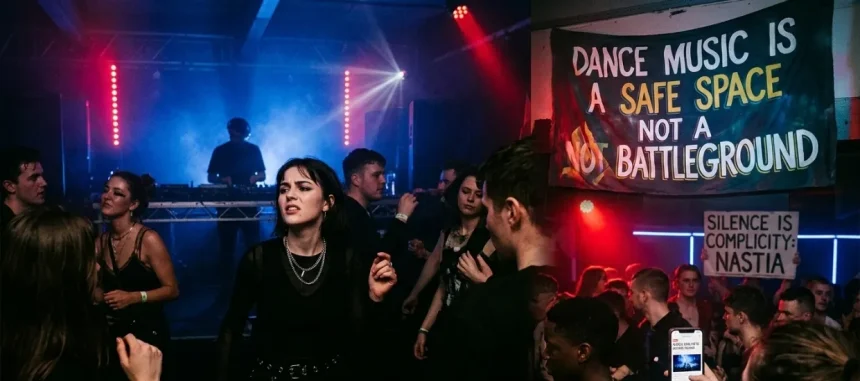
Escapism vs. War: The High Price of Political Activism in Dance Music
The underground techno community is at a crossroads, grappling with an ideological rift as escalating calls for political activism clash with its foundational commitment to escapism and sanctuary. For decades, the dance floor existed as a unique geopolitical anomaly—the one last bastion where the chaos of the outside world was silenced by the harmonious frequencies of Peace, Love, Unity, and Respect (PLUR). Emerging from the marginalized enclaves of Chicago and Detroit, dance music has long served as more than just a genre; it has been a refuge for those seeking acceptance.
The Call for Change
In recent years, figures like Ukrainian powerhouse Nastia have gained prominence in advocating for a radical shift in focus. She argues that the privilege of “just dancing” while ignoring political realities has expired. In a culture that once embraced neutrality, her voice rings as both a wake-up call and a challenge to the status quo. Nastia contends that enjoying this sanctuary requires a deeper engagement with the world outside its walls. As she declared in her 2026 manifesto, the time for complacency has passed.
The Evolving Concept of Safe Spaces
In its early days, the notion of a “safe space” in the dance music scene offered a radical refuge, free from the biases and partisan disputes that plague society. However, as activists such as Nastia frame this form of safety as a luxury that can no longer be afforded, the scene’s ideology is swiftly evolving. To her, the sanctuary is no longer a passive escape; it must now evolve into an active broadcast tower for global awareness.
“Stick to music” has been a phrase wielded to silence artists who dared to speak out, but Nastia argues that the ability to remain neutral is not a shield against criticism but a barrier to meaningful engagement. This shift raises the question: What is the cost of enjoyment in a world so fraught with strife?
Economics vs. Ego: The Price of Activism
In a landscape marked by concern over rising poverty, potential global conflict, and increased economic instability, many ravers view the dance floor as a hard-earned escape—one that allows them to temporarily forget the harsh realities outside. Yet, while headlining artists advocate for political activism from positions of relative security, the average attendee seeks solace, not lectures that pull them back into a tumultuous world.
Nastia’s stance illuminates a disconnect between artists and their audiences. When expressed as an ultimatum—choose activism or face the consequences—this philosophy risks undermining the very ideals that forged the dance community in the first place.
Politics and Division
Incorporating global conflicts into the music scene, as Nastia and collectives like Ravers For Palestine have done, could inadvertently transform the dance floor from an inclusive space into a battleground of ideologies. The transition from “dance floor as bridge” to “dance floor as border” poses a significant risk. Once artists are policed for their national origins or political stances instead of their music, the space ceases to be an escape and begins to mirror the very divisions the community aims to transcend.
The Cost of the Ticket
As prices rise alongside global tensions, the ticket for admission to this once-sacred space transforms into a contract for liberation, however temporary. For many, the dance floor embodies a fleeting moment of joy amidst chaos. If activists succeed in stripping away the luxury of silence, the dance floor risks becoming a microcosm of the conflicts everyone strives to escape.
Nastia articulated this tension poignantly with her statement: “Your position towards war tells who you are.” In this vein, she suggests that confronting these harsh realities is an essential aspect of being both an artist and a citizen today. While the Ukrainian dance floor may still be a sanctuary, Nastia believes it must now be filled with individuals who are “educated and aware” of the shifting geopolitical landscape.
An Inescapable Reality
The emergence of political messaging in the dance music scene frames neutrality in a different light. Artists are increasingly called on to take sides in an age where social media thrives as a platform for warfare, compelling them to choose allegiance; “awareness” risks transforming from a bridge into a border. This fundamental change not only complicates the values inherent in underground culture but challenges the sanctity of the escape that dance music has always offered.
When artists begin weaponizing political views or spectacularizing social issues, they veer into a realm that undermines the core goals of empathy and connectedness that were once so integral to the dance music movement. In a climate where influence can be equated with status, it becomes essential for activists to remember that advocacy should not be a marketing tool, but rather a heartfelt endeavor aimed at fostering genuine awareness and change.
As the dance music community finds itself continuously navigating this ideological labyrinth, the question lingers: Where do we go from here? As tensions intensify and the stakes rise, whether the dance floor will remain a sanctuary of sound or evolve into a political arena remains to be seen.