

Researchers Innovate Advanced Icing Detection System
Researchers supported by the U.S. National Science Foundation (NSF) have made significant strides in safety engineering with the development of advanced sensors capable of measuring surface ice accumulation. These sensors are designed to assess the likelihood of dangerous atmospheric icing conditions, ultimately enhancing the nation’s resilience to the challenges posed by extreme weather.
The Groundbreaking Icing Detection System (IDS)
At the heart of this innovation is a prototype for a new Icing Detection System (IDS). Uniquely equipped, this system has the capability to measure liquid droplets in clouds for the first time. It calculates droplet size and abundance in the vicinity of an aircraft or other vehicles to determine the risk of icing conditions.
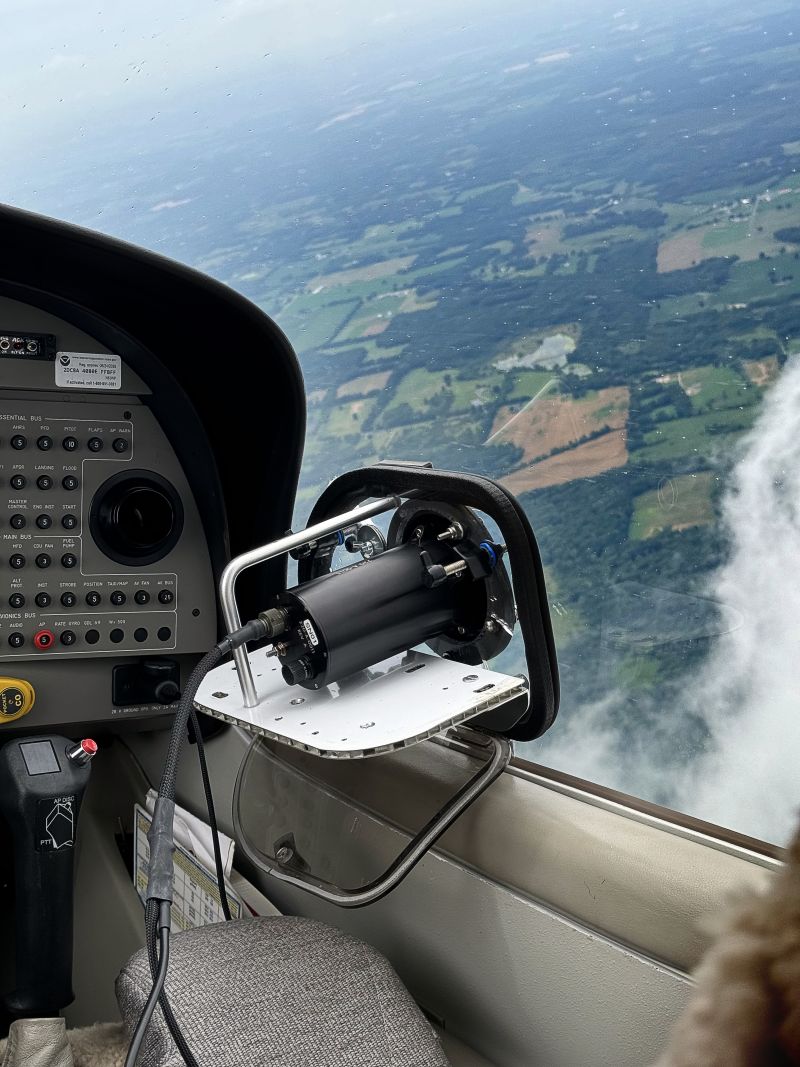
Credit: Rohan Madathil, UM alumnus (CLaSP)
The University of Michigan team flies an airplane equipped with the sensors into a cloudy sky at the Ann Arbor Airport on Friday, July 5, 2024.
According to Nilton Renno, the study’s lead author and a professor at the University of Michigan, “The most hazardous kind of ice forms in temperatures that are just below freezing and when the drops are large.” In these conditions, liquid droplets freeze upon contact with exposed surfaces, such as airplanes, creating substantial icing hazards.
The Severity of Ice Accumulation in Aviation
Ice buildup has dire implications for aviation safety, leading to approximately 10% of all fatal air carrier crashes. Additionally, icy conditions on roads contribute to around 20% of weather-related car crashes each year, underscoring a critical need for vehicles—be it airplanes or trucks—to have reliable icing detection systems.
Recognizing the urgent necessity for such technology, Renno—who also pilots planes—emphasized the importance of quickly detecting potential icing hazards to prompt timely safety protocols.
A New Kind of Sensor Technology
Traditionally, aircraft equipped with Federal Aviation Administration (FAA)-certified icing protection systems estimate ice accumulation through probes on the aircraft’s exterior. The new IDS surpasses these capabilities by measuring ice formation on any surface of the aircraft, while also calculating cloud droplet size and water content. This feature allows flight crews to receive timely alerts about the hazard level, facilitating faster decision-making, such as rerouting flights or activating onboard heating to mitigate ice formation.
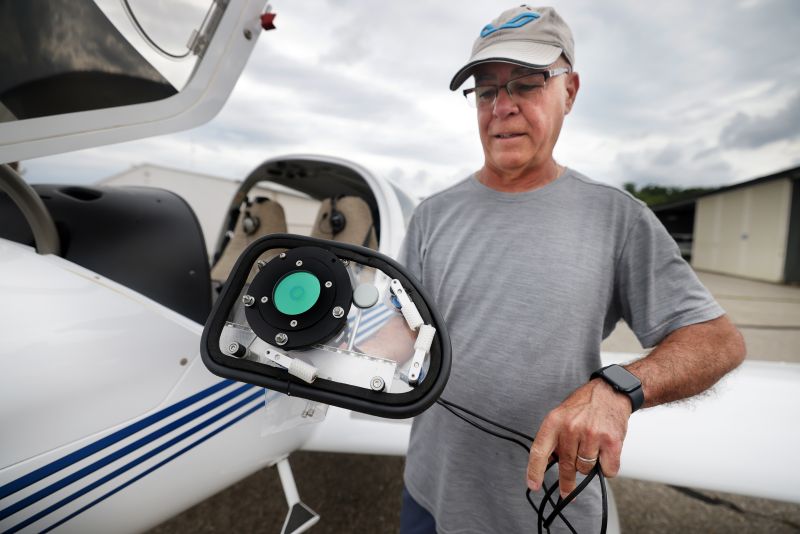
Credit: Brenda Ahearn/University of Michigan, College of Engineering, Communications and Marketing
Nilton Renno holds sensors that allow airplanes to quickly detect when they are flying into freezing rain and drizzle and when ice is accumulating on the plane.
Versatile Origins with a Focus Beyond Aviation
Though initially designed for winter weather conditions, the innovation of the IDS has roots in a study focused on water content in soils for a Mars mission. Renno recalls that during NSF-backed fieldwork at Owens dry lake in California, the team discovered the instrument’s potential to accurately detect phase changes—such as water turning to ice—prompting thoughts of broader applications.
With multiple NSF grants and additional funding, the research team established a database of scientific measurements and furthered device development, conducting part of their work at the University of Michigan Space Physics Research Laboratory. Moreover, the team established Intelligent Vision Systems, a startup aimed at refining the IDS and collaborating with a major aerospace company for future expansions.
For those interested in deeper insights, further details can be found in the University of Michigan’s news release.