
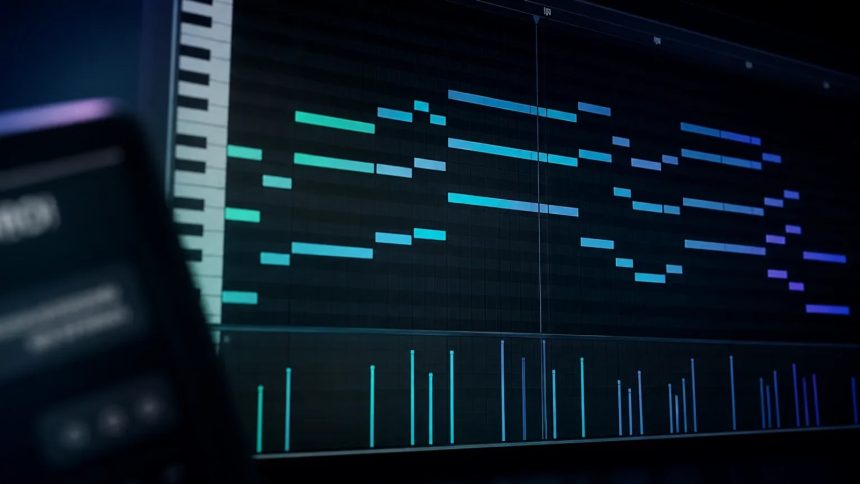
The MIDI Agent is a tool designed to assist music producers by generating MIDI chord ideas based on musical prompts. It can utilize existing MIDI files to provide variations, allowing the user to specify keys, harmonic characteristics, and lengths while working within their digital audio workstation (DAW).
Understanding Chord Progressions
A chord progression outlines the movement between harmonies, while voicing determines the specific notes used and their arrangement. The rhythm further dictates the timing and duration of these notes. These factors are distinct, and altering one may not require a complete overhaul of the chord progression.
For example, a busy progression may benefit from simpler voicings or fewer chord attacks rather than an entirely new sequence. Conversely, a thin-sounding progression may improve with an additional chord tone or by utilizing a different register, all without altering its harmonic trajectory.
Crafting a Chord Example
Producers can start with a chord example to build upon. For an R&B-influenced idea, an effective progression might include Dm9, B♭maj7, Fmaj7, and Cadd9. This allows for an eight-bar phrase with each chord held for two bars, providing sufficient room for melodic elements or vocal lines.
Using MIDI Agent, producers can prompt for a specific composition, such as an eight-bar chord part at a certain tempo, ensuring the chord sequence, feel, and register align with their vision.
Voicing for Smooth Transitions
The voicing—how chords are constructed—can significantly enhance the flow between chords. Making sure to play around with the bass can strongly influence how the notes function. For instance, changing the bass root alters the perception of the upper voicings, which may help create a cohesive sound throughout the progression.
Keeping select notes the same while changing others in a progression can help maintain a sense of connection even as harmonic elements shift.
Rhythm and Chord Structure
Producers can also experiment with different rhythmic patterns while keeping the harmony constant. Starting with sustained chords allows for clarity in movement, after which they can compare versions that employ syncopated attacks to add rhythmic complexity. Using MIDI Agent, variations can be requested that specifically target the rhythm while preserving the harmonic structure.
Supporting Elements with Bass
In terms of arrangement, a well-defined bassline can help emphasize the root of each chord without doubling low frequencies with a second instrument. Rather than complicating the bassline with excessive notes or fills, producers might choose to keep it straightforward, complementing the chord structure while ensuring clarity.
MIDI Agent can generate suitable basslines that align with the harmonic rhythm of the chords if the producer provides the necessary information regarding density and pulse.
Utilizing Chord Tools Effectively
Different chord tools serve unique purposes in the production process. While a MIDI chord pack offers premade examples, a rule-based generator helps to explore combinations within predefined constraints. A dynamic, prompt-based tool like MIDI Agent allows producers to articulate their musical direction and generate variations flexibly.
Developing Musical Sections
On completing an initial chord part, producers can transfer their MIDI into a DAW and establish it within their instrumental tracks. From there, they can gradually develop their composition, allowing distinct elements to emerge over repeated progressions while maintaining the core harmonic essence.
This process fosters a rich interplay of elements in the music, ensuring that each choice enhances the overall impact of the song.
More electronic music news on BEATMAG TV.