
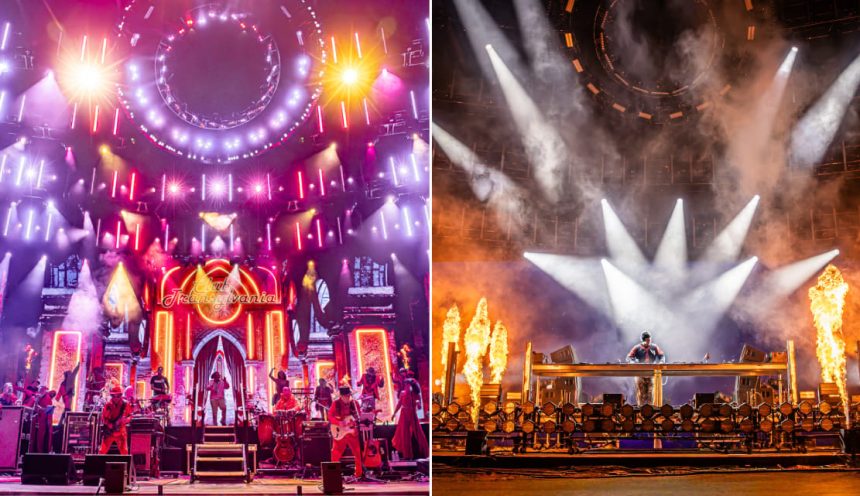
This past week, the music and festival community flocked to the Hulaween 2026 AMA session hosted on the r/electronic subreddit, where veteran festival promoter Michael Berg provided insights into the programming and vision of one of the most beloved multi-genre music festivals in the U.S. Held annually at Live Oak, Florida’s Spirit of the Suwannee Music Park since 2013, Hulaween has evolved considerably over the years, transitioning to include a wide array of electronic acts alongside its traditional jam band roots.
In this candid conversation, Berg articulated a vision that resonates with many fans while navigating through some challenging criticisms. He likened the programming of the festival to creating a Venn diagram, where it is crucial to maintain a balance among the diverse range of fanbases, saying, “We try to keep as much of it near the middle as possible.” When deciding which acts to book, he emphasized their commitment to listening to the community, noting, “The best thing we can do is listen to the community and act on their feedback to the best of our ability.”
However, amid the supportive exchanges, Berg faced pointed questions that felt more like accusations than inquiries. “Where is the jam?” one frustrated commenter lamented. “Why are you sucking the soul out of this festival?” This sentiment was echoed by another, who questioned the reasoning behind the shift towards mainstream EDM styles, asking, “Is there pressure from above? Greed? If the festival is already successful, what’s the motivation?”
While these critiques were stern, they touch on a larger conversation about the changing landscape of music festivals. Hulaween’s programming has increasingly emphasized electronic music over its traditional jam roots, drawing attention from die-hard fans who worry about the festival’s core identity. Berg, who has been integral to Hulaween since its inception, defended the festival’s ethos, contending that these critiques often overlook the broader context of a shifting music scene.
“We are fighting to keep the culture alive,”
Throughout the discussion, it became clear that live bands still hold a considerable presence at Hulaween. In his responses, Berg relayed, “Sucking the soul out of this festival is just your opinion; I beg to differ,” while calling attention to the more than 30 acts spanning jam, rock, bluegrass, and beyond slated for the 2026 lineup. “I can say with full assurance that Hula will remain a multi-genre festival… but the worlds of jam and dance have so much overlap in their cultures, it was bound to see these worlds merge over time.”
Delving deeper, Berg revealed the unfortunate reality that many jam fans who voice their grievances online are not the ones buying tickets to attend the festival. “We are fighting to keep the culture alive… Times change, and people grow past things,” he stated. Despite being a devoted jam band enthusiast himself, Berg argued that incorporating electronic music not only helps the festival sustain its operations but also introduces new audiences to the scene. “If adding some bass acts to the show helps us sell tickets, and we like the music, why would that be greedy?”
In his responses, Berg illustrated a stark truth: “Jam people bitch online but don’t buy tickets like they used to.” He noted that bass music has become a significant driver of ticket sales in a way that jam bands have not maintained. To highlight his point, he cited two events: the ongoing success of North Coast Music Festival, which leans heavily into EDM, and, conversely, the short-lived Sacred Rose, which featured an all-jam band lineup but couldn’t survive after its first year. “It didn’t do well enough to make it to year two, and there wasn’t a single DJ on it,” he remarked with a hint of disappointment.
For Berg, the evolving lineup at Hulaween does not signify a departure from its roots. Instead, he perceives it as a necessary, strategic response to the evolving music industry. He emphasized that without adaptation—like the inclusion of diverse genres—the iconic festival risks disappearing entirely. As he noted, “Today’s best options amount to a multi-genre show like Hula, or promoters like us disappear.”
The rich tapestry of multi-genre offerings at Hulaween suddenly began to reveal itself as a lifeblood that might not only sustain the festival but also the very culture fans cherish. To illustrate the impact of this shift, Berg pointed out how electronic genres provide a clearer demographic appeal, especially among younger crowds, compared to the narrower market of jam bands. He astutely observed that jam festivals face challenges: “Jam band fans are getting older… When you have a city show, it’s that older demographic; they pick the one day they want to go.”
Throughout the dialogue, Berg remained both passionate and reflective about Hula’s evolution. He acknowledged the nostalgia for festivals of yore, likening today’s challenges to a larger cultural state of flux. “Look at Riot Fest,” he said, highlighting how similar nostalgia-driven events can thrive with a focused genre lineup. In contrast, he pointed out that with Hulaween’s diverse offerings, attendees can enjoy a myriad of experiences without sacrificing their love for jam music. “You could go on a band journey all day and never miss a minute of music and never see any electronic music.”
As the conversation concluded, it was evident that Berg’s mission is fueled by a genuine desire to maintain a platform for the genres he loves while embracing the magnetic pull of evolving music trends. He hinted at exciting future concepts, including initiatives with Family Guitars aimed at creating a nurturing environment for burgeoning talent that resonates with the jam band ethos.
Hulaween is set to return to the Spirit of the Suwannee Music Park from October 22nd to 25th, 2026, promising a diverse lineup that celebrates both the charm of jam bands and the allure of electronic sounds. For fans eager to participate in this multi-faceted musical experience, full details about the lineup and tickets can be found here.



