
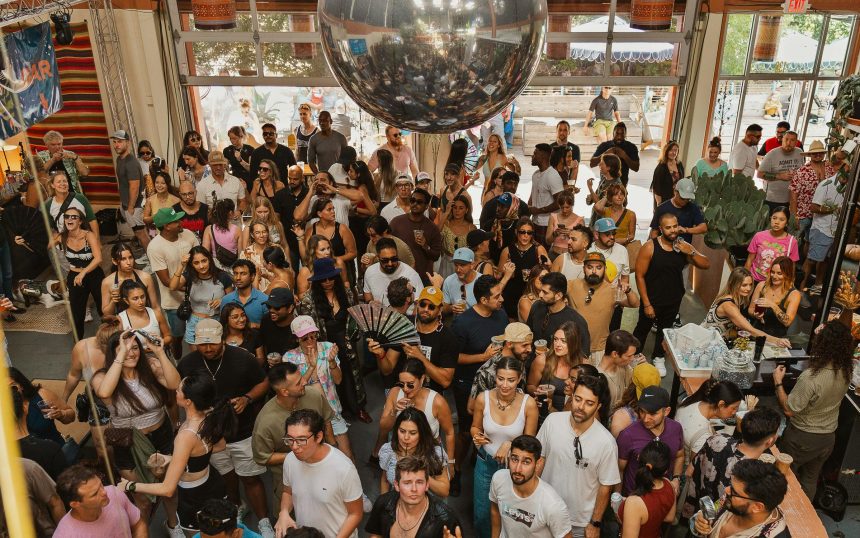
It’s 10:30 a.m. on a sticky Sunday in June, and the crowd at Stargazer, a coffee and cocktail bar on Austin’s East Side, has started to congeal. Dressed in neon athleisure or miniskirts and cowboy boots, young people amble in, phones drawn, ready to snap content. A DJ looms from the mezzanine, fist pumping to EDM in broad daylight. (“It’s my boyfriend’s literal dad. This is crazy!” shouts one woman standing in front.) Espresso martinis and iced vanilla lattes splash in hand as the flock bounces in an attempt to catch the beat, bobbing their heads to the percussive, electronic sound of this coffee “rave.”
When he started his daytime bacchanals, Latt3, last January, entrepreneur Thanh Pham expected forty people to show up. The self-proclaimed tastemaker with the vocal cadence of a business podcaster put out a social media call for a venue two weeks before his first event. A pickleball pal knew of a willing coffee shop owner, and a couple conversations later, Pham texted RSVP links to his friends and other connections. On the day, nearly four hundred people showed up. Just four months later, there were two thousand attendees.
“It’s millennials and Gen Z,” Pham says of his target audience. “We have single moms and single dads coming with their kids. One of the things I’m very proud of is our events are always dog friendly.”
From backgammon groups and run clubs to mahjong leagues and supper clubs, social media–forward microcommunities have surged in popularity as young adults grapple with the loneliness epidemic spurred by the COVID-19 pandemic. They’re also drinking less and increasingly eschewing traditional bars and clubs. But unlike their nighttime counterparts, morning DJ sets don’t draw crowds looking to imbibe, do drugs, or wear something more formal than sweatpants. Young Texans are finding joy in waking up at the crack of dawn to party.
“You don’t feel pressured, you don’t have guys trying to come up and be weird to you, because it’s all in the sunlight and an open space,” says Samantha Berns, a regular at Latt3. “I’ve yet to see people really not start dancing. Even the awkward ones that, arms crossed, sway in the beginning start dancing, because you just feel it in your body with everyone.” Berns adds that she’s started a group chat with other regulars she’s met at Latt3 events, some of whom even planned a birthday dinner for her months later. Latt3 isn’t the only coffee shop rave in town. “It was probably 11:30 a.m. and a beat drops, and this guy is just lifted up in the crowd by his friends, and he’s crowd surfing,” says Austinite Ryan Robinson, who hosts the Morning Spin through her apparel brand the Mushroom Cowboy (which has more than 18,000 followers on Instagram) and has popped up at coffee shops such as Cosmic Pickle, 2nd & Roast, and Mañana. At her first event last January, there were more than six hundred attendees. “It was the best energy ever. People were standing on tabletops. It’s crazy.”

Many ridicule these morning raves as another attention-seeking disruption in Austin’s influencer-infested atmosphere. In one TikTok, a young woman writes, “going to get coffee in austin is lowkey stressful sometimes cause why do i have to check their ig story to make sure i don’t walk into a random dj set at 10 a.m.” That video has 15,000 likes. “How am I supposed to play pickleball AND update my fitness TikTok channel while ALSO standing in line for a coffee shop rave? Life is hard,” jokes a Reddit user in the subgroup R/Austin. “You have to be brave, for your followers,” responds another.
Still, the morning rave movement appeals to young people largely because of growing curiosity around sobriety and desire for physical connection. And Austin—despite being a hub for live music and alternative-wellness cultures—isn’t the only Texan city adopting the trend. A Houston matcha bar, Matcha Mia, offers sporadic house music pop-ups. Café con Ron, hosted by Perreo Club, mainly in the San Antonio–Austin area, has earned a stamp of approval from Bad Bunny. The Berni Bean Coffee Co., in Dallas, is part of an Anti-Snooze Club, complete with cold plunges and yogalates for $30.
Anamaria Garcia, a student at the University of Houston–Downtown, founded her coffee social club, Cafe con Amigos, to highlight the deeper connections between coffee and culture. “In Houston, we have such a beautiful and diverse coffee scene, but I also noticed that there really weren’t many spaces where our Latinidad was the focus of that,” the former barista says. Her club’s Cumbias y Cafe event centers on the music genre that reminds her of family parties spent dancing in the living room and backyard cookouts—something she felt others could relate to.
But Garcia also uses her events as opportunities to learn about the coffee beans themselves and highlight local roasting companies owned by people of color. “It’s beyond music. It’s beyond meeting people and having a good time. I specifically want to be intentional, and I want my club to have some sort of integrity with it,” she says. At her second event, she remembers being struck by partygoers waiting up to forty minutes in the sun to attend.
Inclusivity is also one of the main reasons Jamellia Greathouse, a vocational rehabilitation counselor, created Out tha Gate, a series of “anti-gatekeeping groove sessions” for music lovers across San Antonio to share new artists and deep cuts.
By starting in the morning, Greathouse wants attendees to be able to kick off their “Sunday funday” and continue the party elsewhere. But the timing is also meant to appeal to those who can’t typically attend evening raves either. Greathouse is legally blind, and going out at night can present challenges. “I didn’t want to create something that I would have difficulty navigating. I have other friends that are in the community, and I wanted to be able to do something that they would be able to attend without it being so much about the disability itself but just another space where they’re like, ‘Okay, I can go have fun too.’”
The crowd at Latt3 never lets up all morning, with gaggles of students, couples, and families flocking toward and from the bar like birds at a watering hole. A new DJ transitions in (he favors pop throwbacks), and he is joined by hired dancers, bubble guns ablaze. Smoke machines saturate the air, providing little relief to the hardcore revelers sweating up front.
Robinson, of the Morning Spin, is aware of the comments and backlash online. But she’s also undeterred by the haters. She makes sure that her events aren’t on consecutive days to respect shop owners and those who just want a quiet weekend to study or grab a cup of joe. “We’re not trying to disrupt anyone’s peace. We’re trying to make a safe space for everyone of all ages—sober or mimosa drinkers—to come and be together,” she says.
She also maintains that coffee shop raves are true to the city’s ethos. “If anyone thinks that’s not Austin, I’d say, are you really from Austin? Because it’s Keep Austin Weird. And I’d also say, come dance with us if you think that, and maybe we’ll change your mind.”