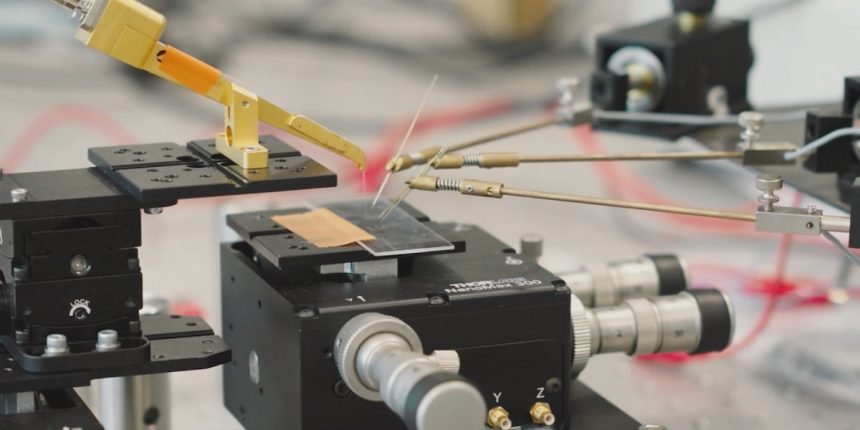
HIPER-X: Revolutionizing Computing with Light
Introduction to HIPER-X
Gainesville, Florida is buzzing with innovation as the University of Florida continues to pave the way in semiconductor technology. In a recent Tech Tuesday segment, UF Innovate spotlighted a groundbreaking technology known as HIPER-X. This advanced system harnesses the power of light to enhance communication speeds in computer chips while simultaneously reducing energy consumption—an urgent need in today’s data-driven world.
The Brain Behind the Breakthrough
At the heart of HIPER-X’s development is Dr. Hangbo Yang, a research associate professor in the Electrical and Computer Engineering (ECE) department at UF. Dr. Yang explained, “HIPER-X is an XPU cluster designed to accelerate computing calculations.” This innovative architecture facilitates rapid, all-to-all communication among cores, enabling them to communicate instantaneously without the need for rerouting through other cores. Such a setup not only improves processing speed but also minimizes energy usage—a critical factor as we increasingly rely on high-performance computing capabilities.
The Need for Energy Efficiency
As artificial intelligence models like ChatGPT and Gemini grow in complexity, their energy demands have surged accordingly—particularly in data centers that can be energy-intensive. Dr. Yang highlighted this concern: “Each data center consumes a lot of energy.” By employing photonic technology, HIPER-X aims to offer a viable solution to curb this ever-increasing energy footprint, making high-performance computing greener and more sustainable.
What is Photonics?
The concept of photonics may be novel to many, but it forms the backbone of HIPER-X. Dr. Yang describes photonics as “optics on a semiconductor chip,” utilizing photons instead of electrons for computation and communication. This shift creates a paradigm where signals can be transmitted and received more effectively. Notably, HIPER-X stands out in the tech landscape; as Dr. Yang remarked, “There is no such kind of technology or company doing this work.”
Collaborative Development and Space Ventures
The development of HIPER-X is a collaborative endeavor, involving partnerships with leading tech companies like NVIDIA. Together, these teams are crafting a robust framework for this state-of-the-art technology. To test its resilience and functionality under extreme conditions, some chips—referred to as JTC and PTC—have already been launched into space in partnership with NASA. These chips are on a mission to demonstrate their capabilities in long-distance communication between satellites and spacecraft, signifying a leap forward in aerospace technology as well.
Conclusion
HIPER-X embodies a significant advancement in the realm of semiconductor technology, featuring the potential to dramatically improve computing efficiency while also addressing the critical issue of energy consumption. As developments continue, the collaboration between university researchers and industry leaders sparks hope for a more sustainable and high-performing future in computing.