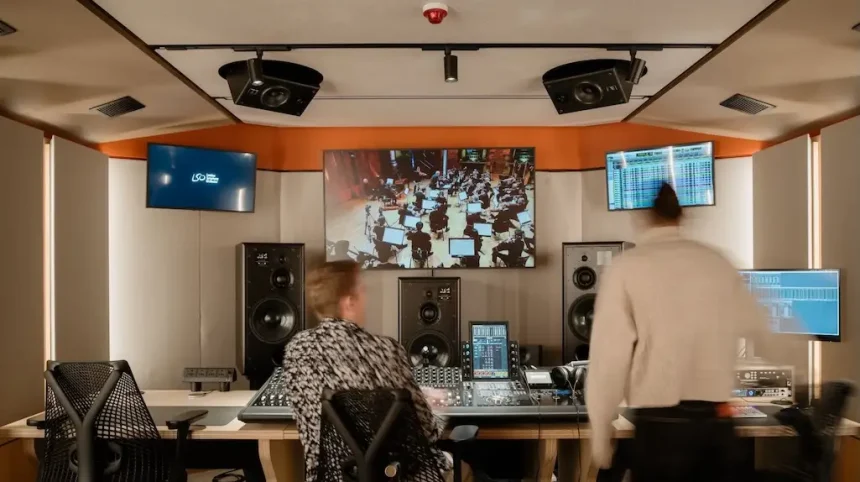
LSO St Luke’s, the London venue best known as the home of the London Symphony Orchestra, has opened a new recording studio as part of a major investment in its creative and technical infrastructure.
The new Audio Control Room brings modern production capabilities into the historic Old Street building, combining state-of-the-art recording technology with one of London’s most distinctive performance spaces. Equipped with a Dolby Atmos 7.1.4 monitoring system, ATC speakers and an Avid S4 console, the studio has been designed for a wide range of professional uses, including recording, mixing, spatial audio and post-production.
A key feature of the new setup is its connection to every performance space inside the building, allowing artists, engineers and production teams to capture performances across the venue with greater flexibility. This makes LSO St Luke’s suitable not only for orchestral and classical projects, but also for experimental music, electronic performance, broadcast work and filmed content.
The redevelopment also includes upgrades to the venue’s Master Control Room, improving capacity for livestreams, broadcasts and video productions. The refurbished Clore Rooms will now serve as adaptable spaces for rehearsals, recording sessions and creative production, while acoustic improvements have been made throughout the building.
Originally opened as St Luke’s Church in 1733, the Grade I-listed building was transformed into the London Symphony Orchestra’s music education and performance centre in 2003. Since then, it has become a respected venue for both orchestral work and adventurous contemporary music.
Alongside its classical programming, LSO St Luke’s has hosted performances and recording sessions by artists including Yasuaki Shimizu, James Holden, Raime and Lustmord, reflecting its importance as a bridge between traditional performance, experimental sound and modern production.
With the new facilities now available to hire, LSO St Luke’s enters a new chapter as a high-end creative hub for recording, broadcast and spatial audio projects.
For a building with nearly three centuries of history, the upgrade feels like a natural evolution—honoring its past while opening the door to the future of sound. 🎙️🎶🏛️