The Return of Superconducting Circuits: A Quantum Leap Forward
A Nostalgic Retrospective
The 1980s were a vibrant decade marked by revolutionary shifts in technology and culture. Amidst the iconic music, fashion, and cultural phenomena, another significant innovation was quietly taking shape: superconducting circuits. In 1980, IBM confidently bet on this promising technology, envisioning computers that operated with unprecedented efficiency. The excitement even made it onto the cover of Scientific American. However, as we know, this anticipated technological revolution never materialized, leaving superconducting circuits to fade into obscurity—much like other aspects of the decade’s fashion trends.
SEEQC: Breathing New Life into Superconductors
Fast forward several decades, and a company named SEEQC is reviving this overlooked technology with an eye toward quantum computing. Nestled in upstate New York, SEEQC has transformed remnants of IBM’s discontinued superconducting computing program into a promising venture aimed at fundamentally reshaping how we harness computing power.
During a visit to SEEQC’s state-of-the-art quantum chip foundry, the atmosphere buzzed with energy. Technicians in full-body protective suits navigated a world of precisely controlled environments, where layers of niobium—the superconducting metal—were meticulously layered onto dielectric materials. Each step in this delicate process is crucial; any misalignment could disrupt the quantum processes that underpin their function.
Challenges of Traditional Electronics
Superconductors are unique—they transmit electricity without resistance, meaning they don’t waste energy as heat, a common issue with conventional electronics. Michael Frank poignantly captured this dilemma in 2017 when he quipped that a regular computer is essentially “an expensive electric heater that happens to perform a small amount of computation as a side effect.” Imagine a world where charging your devices didn’t generate unnecessary heat—a world only possible through superconducting technology.
Yet there’s a catch: superconductors only operate effectively at extremely low temperatures or under high pressure. Historically, maintaining such conditions has proven inconvenient and costly, prompting IBM to halt its superconducting computing efforts in 1983 as heat-producing conventional computers rose to prominence.
The Quantum Resurgence
The scientific landscape shifted dramatically in 1999, when researchers in Japan developed the first superconducting quantum bit, or qubit. This groundbreaking advancement opened doors to an entirely different realm of computing, where information is processed using principles that defy classical computation. Fast-forward to today, and companies such as Google and IBM leverage superconducting qubits to facilitate some of the world’s most powerful quantum computers.
Despite these developments, quantum computers have yet to deliver on their potential for transformative breakthroughs, such as breaking encryption or discovering new pharmaceuticals. The engineering challenges remain substantial, making it clear that the quest for practical quantum computing is far from over.
SEEQC’s Vision for the Future
At SEEQC, there’s a palpable sense of optimism. CEO John Levy envisions a new generation of superconducting chips capable of significantly enhancing quantum computers’ scalability and efficiency. Currently, quantum computers require a range of bulky and energy-hungry components—not just to cool the qubits but to control and monitor them as well.
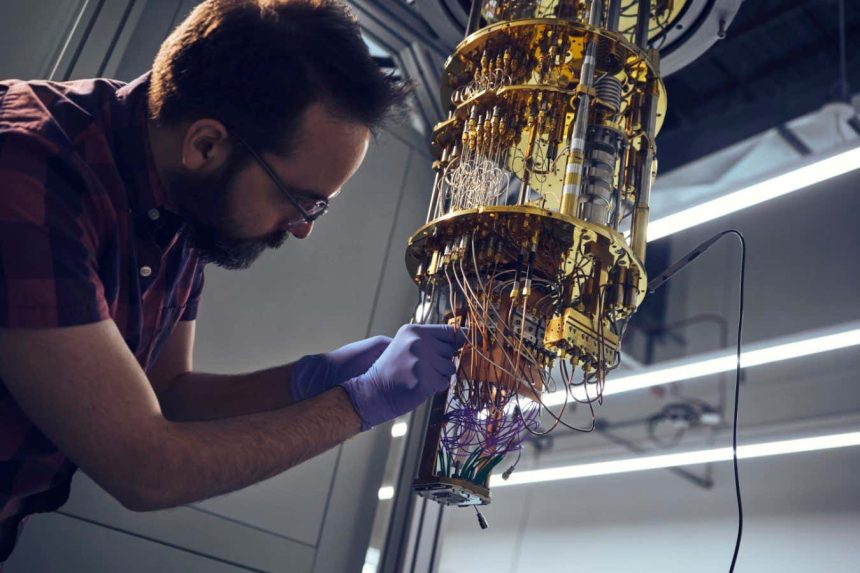
A standard superconducting quantum computer includes a chip packed with qubits situated inside a dilution fridge. This setup can become unwieldy. With each additional qubit, the system demands more cables and control units, which introduce heat and complexity—factors that significantly hinder performance.
Levy insists that SEEQC’s chip aims to replace multiple components traditionally necessary for operating a quantum computer, making the entire system more efficient and compact.
The Innovative SEEQC Chip
The SEEQC chip, small and unassuming, embodies a profound innovation in quantum computing. One segment houses the superconducting qubits, while the larger section is a control chip crafted from superconducting materials as well. This allows for the entire system to be kept in the same ultra-cold environment, thereby minimizing the need for additional components that typically operate at room temperature.
The benefits are substantial: by eliminating extra heat sources, SEEQC posits that their approach could yield a billion-fold increase in energy efficiency for quantum computers. Current estimates indicate that scaling quantum computers could require energy levels exceeding those of conventional supercomputers—a hefty price many hope to avoid.
Moreover, by keeping digital control signals proximal to the qubits, latency and inefficiencies in communication are greatly reduced. This setup significantly enhances their reliability and decreases the likelihood of unintended errors, setting the stage for a more robust quantum computing landscape.
Overcoming Technical Hurdles
The road ahead, however, is not devoid of challenges. Superconductors can easily be influenced by nearby magnetic fields, leading to unwanted quantum vortices that disrupt performance. To counteract this issue, SEEQC has pioneered innovative techniques to neutralize these pitfalls, showcasing the importance of ongoing research in superconducting physics—something even the most advanced technologies cannot sidestep.
As SEEQC forges ahead, the promise of superconducting circuits might be on the brink of achieving what once seemed like a distant dream. While echoes of the 1980s have resurged in the quantum domain, one can only hope that the shoulder pads of old remain a thing of the past.