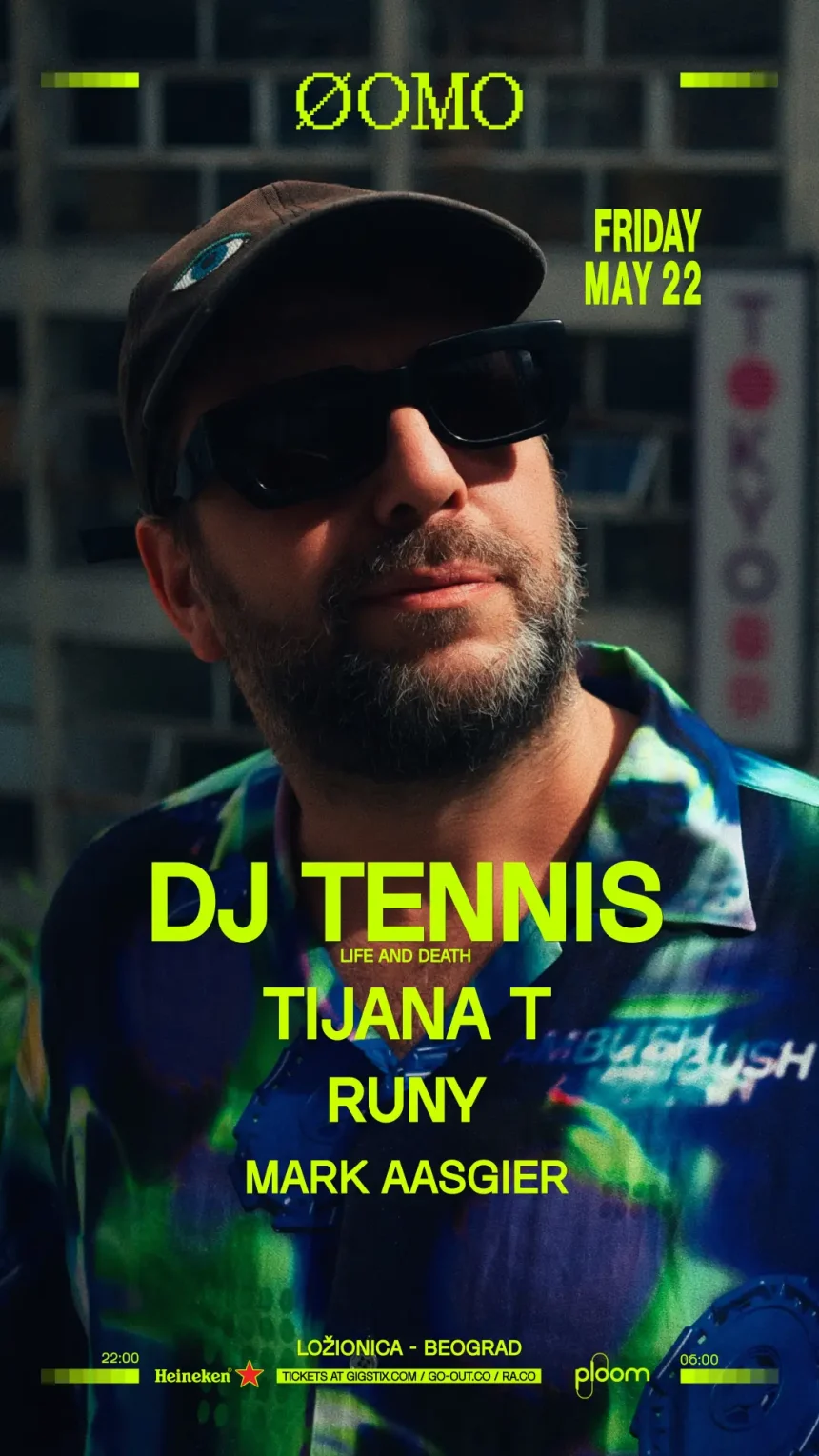
On May 22, FOMO brings one of contemporary electronic music’s most respected and unpredictable selectors to Belgrade as DJ Tennis takes over Ložionica for a special night stretching deep into the early morning hours.
For many artists, longevity in electronic music comes from consistency.
For DJ Tennis, it came from refusing to stay still.
Born Manfredi Romano, the Italian DJ, producer and founder of the influential Life and Death label has spent years building a career that exists somewhere between underground credibility, artistic experimentation and global club culture. While many DJs become associated with a single sound or trend, DJ Tennis continuously moves across genres and atmospheres without losing the emotional identity that defines his sets.
That openness has made him one of the most distinctive figures in modern dance music.
Long before becoming a globally recognized DJ, Romano was immersed in Italy’s punk scene, organizing illegal events and underground gatherings that shaped his understanding of music culture far beyond the boundaries of club functionality. That DIY mentality still echoes throughout everything connected to DJ Tennis today.
His sets rarely follow obvious structures.
House, techno, disco, psychedelic textures and obscure leftfield records blend together naturally, often unfolding slowly through tension, emotion and unexpected transitions. Instead of forcing dancefloors into constant peak moments, DJ Tennis builds atmosphere patiently, allowing rhythm and storytelling to evolve organically over hours.
That philosophy helped transform Life and Death into one of the defining electronic music labels of the last decade.
Founded alongside Greg Oreck, the label became internationally respected for emotionally rich and genre-fluid releases that pushed beyond traditional dancefloor formulas. Artists connected to the imprint helped redefine melodic house and indie-electronic crossover culture without sacrificing underground credibility.
At the same time, DJ Tennis himself continued becoming a global club fixture.
From Circoloco Ibiza and Fabric London to Coachella and major festival stages worldwide, his performances built a reputation around unpredictability and deep musical intuition rather than trend-driven selection. His celebrated residency at London’s Phonox in 2022 further reinforced his status as a DJ capable of controlling rooms through subtle progression and emotional pacing rather than spectacle alone.
Outside music, Romano’s personality remains equally eclectic.
Based in Paris, he is known for passions extending far beyond nightlife culture itself — from cooking and cycling to collecting vintage action figures and maintaining a vinyl archive reportedly containing more than 11,000 records.
That obsessive relationship with music history becomes immediately audible inside his sets.
Every transition feels informed by decades of listening, collecting and cultural curiosity.
For Belgrade, the setting feels especially fitting.
Ložionica has increasingly emerged as one of the city’s strongest large-scale spaces capable of balancing industrial atmosphere with contemporary electronic programming. The venue’s raw architecture and immersive layout create an environment particularly suited to longer-form dancefloor experiences — exactly the kind of setting where DJ Tennis tends to thrive.
The local support lineup also reflects the strength of the regional scene itself.
Tijana T joins the bill as one of the Balkans’ most internationally respected electronic music figures. Across years of performances, broadcasting and curatorial work, she has become synonymous with intelligence, precision and uncompromising musical direction within the wider European underground.
Runy adds another layer through groove-driven energy and instinctive dancefloor control, while opening duties fall to Mark Aasgier, a rising local name steadily gaining recognition through carefully curated selections and understated confidence behind the decks.
Together, the lineup creates a night built less around explosive moments and more around flow, atmosphere and collective immersion.
That balance mirrors exactly what makes DJ Tennis such a compelling artist in the first place.
In a club landscape increasingly dominated by short attention spans and algorithm-friendly predictability, he continues representing something far more human:
curiosity, emotional depth and the idea that a dancefloor can still become an evolving story rather than simply a sequence of drops.
On May 22, Ložionica becomes the setting for that story in Belgrade.