There are club nights, there are promoters, and then there are institutions that quietly reshape an entire city’s nightlife identity over decades.
Future Scope belongs to that last category.
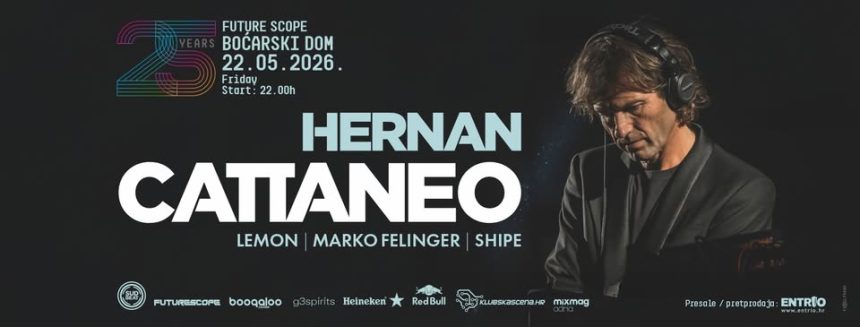
On May 22, one of Croatia’s longest-running and most influential electronic music brands celebrates its 25th anniversary with a massive event at Boćarski Dom in Zagreb, headlined by progressive house icon Hernan Cattaneo.
But this story did not begin with huge productions, giant LED walls or internationally recognized superstar DJs.
It started in 2001 inside the former OTV Dom, when a small crew connected to Radio Cibona decided Zagreb deserved something bigger.
On March 30 that year, around 1,000 people gathered for the very first Future Scope party. Slovenian DJ Aleksij stood behind the decks, while the people organizing the event had little more than passion, belief in music and an almost stubborn conviction that Croatia could sustain a world-class electronic music scene.
There was no major industry backing.
No corporate machinery.
Just pure enthusiasm.
Twenty-five years later, that same vision has helped shape generations of clubbers, artists and promoters across Croatia and the wider region.
Future Scope’s history mirrors the evolution of electronic music culture itself.
During the early 2000s, while many local scenes still treated techno and progressive music as niche movements, Future Scope was already bringing internationally respected artists into Zagreb while simultaneously pushing club culture beyond traditional boundaries.
Some moments have since become part of local rave mythology.
Like the now legendary Murter storm in 2002, where weather chaos nearly destroyed the setup while music somehow continued uninterrupted through the madness.
Or the 2003 beach gathering at Čigrađa on Murter, where more than 2,000 people danced through the night with Jack De Marseille in what many still remember as one of the defining open-air electronic music events of that era in Croatia.
Then there are the stories that only make sense years later.
Future Scope hosted Amelie Lens inside Boogaloo long before she became one of the world’s biggest techno artists — at a time when barely 200 people stood on the dancefloor watching someone who would eventually headline the world’s largest festivals.
That willingness to recognize artists before mainstream hype became part of the collective’s identity.
Over time, Future Scope expanded far beyond Zagreb club walls.
Jarun became another turning point, allowing the organization to move into larger outdoor productions and establish electronic music events on a scale Croatia had rarely seen before. Suddenly, Future Scope was no longer simply a club series — it became part of the country’s broader festival and open-air culture.
Across the years, the list of artists hosted by Future Scope reads almost like a condensed history of modern electronic music itself.
Jeff Mills.
Derrick May.
Sven Väth.
Richie Hawtin.
Paul Kalkbrenner.
Fatboy Slim.
Boris Brejcha.
Charlotte de Witte.
Amelie Lens.
Joseph Capriati.
And many more.
Different generations, different sounds and different eras all passed through Zagreb under the same banner.
Yet despite the scale of those bookings, the core philosophy behind Future Scope remained remarkably consistent:
bringing Croatia club experiences that could stand next to any major European electronic music destination.
That consistency helped Future Scope survive changing trends, economic crises, technological shifts and the constant transformation of nightlife culture itself.
Over the years, the organization also became deeply connected to the emotional memory of Zagreb nightlife.
For many people, Future Scope was never just about lineups.
It became associated with sunrise moments, friendships, first parties, life-changing nights and the collective emotional release that only certain dancefloors manage to create.
Those memories now stretch across entire generations.
The anniversary celebration itself feels carefully chosen.
Few artists embody longevity, emotional depth and timeless club culture better than Hernan Cattaneo.
The Argentine DJ and producer arrives in Zagreb as one of the most respected figures in progressive house and melodic electronic music history. Born in Buenos Aires, Cattaneo built his global reputation through marathon DJ sets defined by patience, emotional storytelling and extraordinary musical precision.
His international breakthrough came after Paul Oakenfold invited him to become a resident at the legendary Cream club in Liverpool while also joining global tours alongside him. Oakenfold repeatedly described Cattaneo as one of the most talented DJs of his generation — recognition that helped launch a worldwide career now spanning more than three decades.
Today, Hernan Cattaneo remains one of the few artists capable of connecting multiple eras of club culture without ever sounding trapped by nostalgia.
His sets often stretch beyond six hours, unfolding slowly through progressive house, melodic techno and deep atmospheric textures that feel more cinematic than functional.
As both a DJ and label owner through Sudbeat Music, Cattaneo has consistently prioritized emotional depth and artistic identity over short-lived trends.
That philosophy aligns naturally with Future Scope itself.
Joining him at Boćarski Dom are respected Croatian artists Lemon, Marko Felinger and Shipe — names deeply connected to the local electronic scene and long-term supporters of the culture Future Scope helped build.
The event takes place on Friday, May 22 at Boćarski Dom in Zagreb.
But in reality, this is much bigger than one night.
It is the celebration of 25 years spent proving that electronic music culture in Croatia could grow into something lasting, meaningful and globally relevant.
And after everything Future Scope survived and created over those decades, that achievement may be its greatest legacy of all.