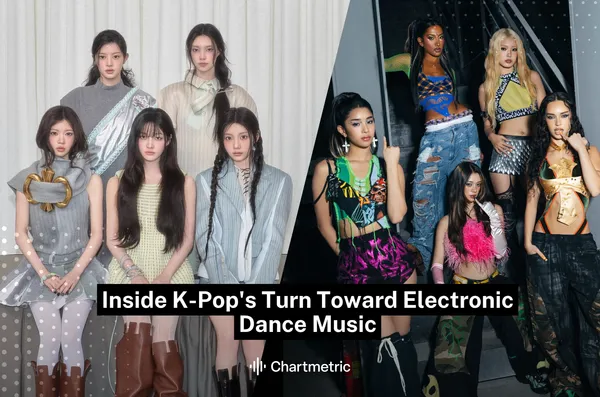
The Emergence of Hard Techno in K-Pop: A New Era Begins
As KATSEYE makes waves with their arena-rave world tour, a radical evolution is unfolding within the K-pop soundscape. No longer is the genre confined to light-hearted trap beats and glossy pop production; a gritty new vibe is reshaping its core. With songs like KATSEYE’s “Pinky Up,” BLACKPINK’s “JUMP,” and LE SSERAFIM’s “CELEBRATION,” it’s clear that hard techno has entered the chat, marking a significant shift in K-pop’s musical identity.
Shattering the Mold: KATSEYE’s Transformative Performance
At a recent show at The O2 in London, KATSEYE, even with two members absent due to health issues, delivered a spectacular showcase that was anything but typical. The electrifying atmosphere was palpable as techno beats collided with the youthful energy of their audience, many of whom had likely never experienced such a sonic intensity live. This performance featured a high-octane rendition of “PINKY UP,” the most popular track from their EP WILD, with an impressive 235.7 million Spotify streams to date. The hype surrounding their music reflects a dynamic shift towards heavier, more pulsating rhythms in K-pop.
Rising Beats: The Hard Dance Movement Takes Hold
KATSEYE isn’t alone in this venture into harder sounds; LE SSERAFIM is also embracing this new direction with their track “CELEBRATION.” Alongside BLACKPINK’s “JUMP,” these groups are signalling a departure from K-pop’s traditional EDM roots in favor of hardstyle, a genre known for its aggressive beats and high energy. Publicist David Lim attributes this trend to a saturation of earlier dance genres and suggests that this transition stems from a need for “a different flavor of dance music.”
He further explains, “Harder beats and more aggressive rhythm framings allow performers to showcase sharper, high-intensity choreography.” This is particularly significant in K-pop, where visual impact is paramount.
Cultural Influences and the Global Landscape
Lim posits that this shift towards hard dance music parallels a broader global interest in more intensive electronic styles. Notable artists like Charli xcx, Shygirl, and PinkPantheress are already popularizing harder sounds in the mainstream, which K-pop appears to be picking up on. Following aespa’s innovative tracks “Supernova” and “Whiplash,” which seamlessly blended hyperpop with gritty industrial elements, the stage was set for a faster tempo in K-pop.
The pandemic-induced surge in international touring has further influenced this evolution. According to Lim, “We can’t underestimate the importance of a rocket-fuelled dance banger to create euphoric moments for fans.” Enthusiastic performances that blend frenetic rhythms and captivating choreography resonate strongly, enhancing the live concert experience.
Engaging the Younger Audience
While this heavy sound may not be suitable for every K-pop artist, it presents a unique opportunity to capture the attention of younger audiences. With shortened attention spans and a penchant for the visceral, high-octane experiences of live performances, tracks like “PINKY UP” and “CELEBRATION” provide a thrilling alternative to the pop formulas that have dominated the genre. The connection between modern K-pop and the electronic underground allows fans to engage with techno and rave music, broadening their musical horizons.
The Critique of Evolution: Friends and Foes
The reaction to this genre shift has been mixed. Some music critics have dissected KATSEYE’s “PINKY UP” as either a refreshing reimagining of their sound or a capitulation to the so-called “TikTokification” of music. While some argue against the track’s artistic merit, others, like those at The Bias List, see the emergence of hard techno as a welcome development that breathes new life into K-pop sonically.
Journalists have noted the distinct atmosphere that songs like “CELEBRATION” create; a fusion of energetic beats and bold aesthetics provides an exhilarating listening experience. The allure of hard techno lies not just in its sound but also in its potential to challenge and excite both artists and audiences.
Collaborations and Futures: A New Sonic Landscape
The intersection of K-pop and hard techno has never been more pronounced. With frontrunners like horsegiirL integrating K-pop elements into the club scene and figures like Sara Landry remixing K-pop tracks, 2026 is revealing itself as a pivotal year for both genres. Lim anticipates further collaborations that will enrich the relationship between K-pop idols and electronic music artists, opening up new audiences while fortifying existing fanbases.
The global dance music stage is evolving, and K-pop is actively participating in this transformation. While the commercial success of this shift remains to be seen, it undoubtedly holds significant implications for the future of K-pop and electronic music at large. The movement toward harder, more intense sounds not only creates exhilarating performances but also inspires fans to explore diverse musical landscapes. With this momentum, the K-pop industry is on the brink of a revolutionary shift, offering something electrifyingly fresh.
Exploring K-Pop’s Shift Towards Electronic Dance Music