
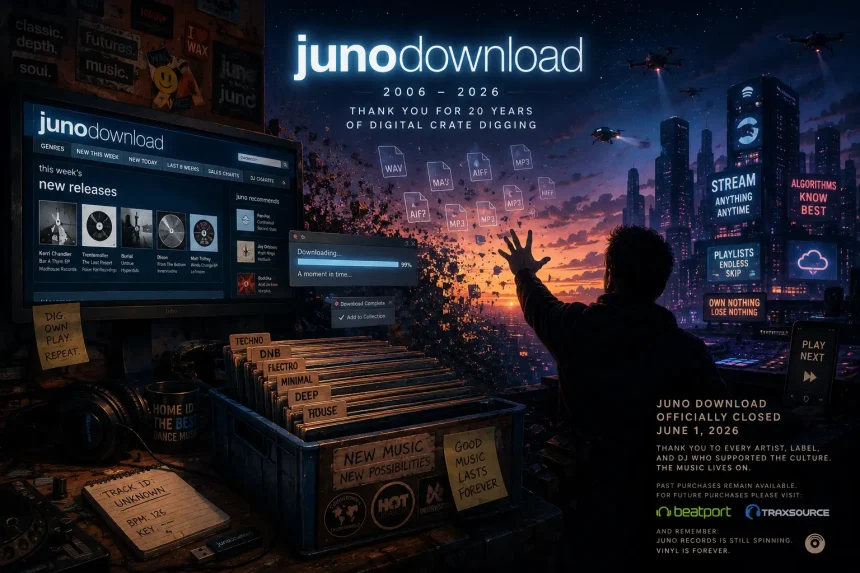
For an entire generation of DJs, producers and electronic music enthusiasts, discovering new music once meant something very different than it does today.
There were no algorithmic playlists deciding what you should hear next. No endless streams of personalized recommendations. No social media clips turning tracks into overnight sensations.
Instead, there was digging.
Hours spent scrolling through genres, labels and charts. Listening to snippets. Comparing releases. Reading artist names you had never encountered before. Building a collection track by track, purchase by purchase.
For many people around the world, that journey happened on Juno Download.
After twenty years in operation, Juno Download officially closed its digital music store on June 1st, 2026. Existing customers can still access and download previously purchased music, but the storefront itself is gone. No new purchases can be made. The company cites the dominance of streaming services and the rise of direct-to-fan platforms such as Bandcamp as the primary reasons behind the decision.
On paper, it is simply another online store shutting down.
In reality, it represents something much bigger.
It marks the end of one of electronic music’s most important digital institutions.
To understand why the closure resonates so strongly, it helps to remember the environment in which Juno Download emerged.
When the platform launched in 2006, digital DJing was still in its formative years. Vinyl remained king in many corners of club culture, while CDs were widely used by working DJs. Download stores were beginning to change the landscape, but the industry was still adapting to a world where music could be purchased and delivered instantly.
Juno Download arrived at exactly the right moment.
Building on the reputation of its physical counterpart, Juno Records, the platform quickly became one of the most trusted destinations for electronic music. House, techno, drum & bass, dubstep, trance, minimal, electro, breaks and countless niche genres all found a home within its catalog.
Unlike many mainstream music services, Juno understood dance music culture.
It wasn’t designed for casual listeners.
It was built for people who cared about labels, catalog numbers, release dates and obscure B-sides.
It became a place where DJs could discover music beyond the obvious hits. A place where small independent labels could stand next to internationally recognized imprints. A place where digging still mattered.
For many artists, having a release appear on Juno carried genuine significance.
The platform helped launch careers, support independent labels and connect underground music with global audiences. Long before social media became the dominant promotional tool, many producers found their first international listeners through online stores like Juno.
The experience itself felt different from modern music consumption.
Buying a track required commitment.
You listened carefully before making a purchase because every addition to your collection mattered. Music wasn’t something rented through a monthly subscription. It was owned.
That distinction feels increasingly important in 2026.
Streaming has undeniably transformed how people access music. Millions of tracks are available instantly, often for less than the price of a single digital release from the download-store era. The convenience is unmatched.
Yet convenience comes with trade-offs.
Streaming encourages abundance. Ownership encourages attachment.
When DJs purchased music through Juno Download, they built personal archives that reflected their identity. Collections evolved slowly and deliberately. Every track represented a conscious decision.
Today’s algorithms often remove that process entirely.
Music finds the listener instead of the listener finding the music.
For younger audiences, that may seem perfectly natural. For many veteran DJs, however, something valuable has been lost along the way.
The closure of Juno Download feels symbolic because it represents the gradual disappearance of digital crate digging itself.
The culture hasn’t vanished completely. Platforms like Bandcamp continue to support independent artists and foster direct relationships between creators and audiences. Beatport remains a dominant force in DJ culture, while Traxsource continues serving specialist communities.
But the landscape is undeniably different.
The golden era of download stores has passed.
Perhaps the most poetic aspect of this story is that while Juno Download disappears, Juno Records survives.
The company’s physical music operation remains active, continuing to sell vinyl to collectors, DJs and music lovers around the world.
In a strange way, the outcome feels fitting.
For years, people predicted the death of physical formats. Yet vinyl endured. It survived streaming, piracy and digital downloads. In many ways it became stronger by embracing its identity as a tangible object rather than simply a delivery system for music.
Meanwhile, digital download stores found themselves squeezed between two powerful forces: streaming on one side and direct-to-fan platforms on the other.
Juno Download ultimately became a casualty of that transformation.
Yet its legacy remains impossible to ignore.
For twenty years, it served as a gateway into electronic music culture. It introduced listeners to unknown artists, helped labels reach new audiences and provided a home for countless scenes that existed far beyond the mainstream spotlight.
Most importantly, it preserved a way of interacting with music that valued curiosity.
The closure of Juno Download does not mean people will stop discovering great music.
But it does signal the end of a chapter.
A chapter defined by patient searching, carefully chosen purchases and the quiet excitement of finding a track nobody else had heard yet.
For those who spent years filling digital crates one download at a time, June 1st, 2026 will be remembered as more than the day an online store disappeared.
It will be remembered as the day a piece of electronic music culture quietly signed off.
And somewhere, in hard drives filled with thousands of carefully selected tracks, the spirit of digital crate digging lives on.