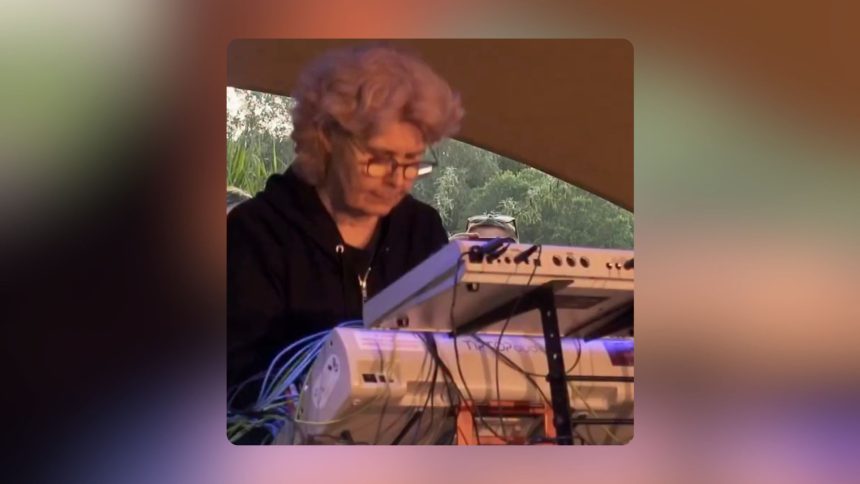
On May 17, 2026, Andrea Gill, known artistically as The Tunegirl, captivated the audience at Awakenings Upclose in Amsterdam. At the age of 63, she took the stage alongside notable artists such as Colin Benders, Dasha Rush, Rødhåd, and Luke Slater. What makes Gill’s story even more remarkable is that she balances her burgeoning music career with a regular day job, defying the conventional expectations of the electronic music scene.
Hailing from Melle, a quaint town in Lower Saxony, Germany, Gill is a modular synthesizer artist whose performances are entirely hardware-based. Her setup features a daunting Eurorack system with 188 modules, and she eschews laptops and pre-arranged sequences in favor of real-time improvisation through live patching. The result is a sound deeply influenced by Detroit’s minimal techno and house music.
Background
Andrea’s musical journey began in the vibrant 1970s, where she became enamored with rock bands like AC/DC and Status Quo. Self-taught on the guitar, she played in school bands, gradually developing her proficiency and musical sensibilities. During the early 1980s, she took to the decks as a DJ at a local disco, spinning a blend of disco, funk, and soul tracks. It was a bandmate’s Yamaha synthesizer during this period that ignited her first curiosity about electronic music.
By the 90s, her focus had shifted towards techno, drawing inspiration from icons such as Jeff Mills, Robert Hood, and Richie Hawtin. She established a production studio featuring an Atari computer running Steinberg Cubase, along with classic gear like a Roland D-20 and Juno-106. However, in 1999, Gill made the decision to sell her equipment and prioritize family life, stepping away from music for a decade.
The Return and the Shift to Modular
In 2009, after a ten-year hiatus, Gill reignited her passion for music, initially exploring software options like Propellerhead Reason and Ableton Live. Yet, she found the linear nature of software frustrating, viewing it as a barrier to her creative expression. This led her to revisit hardware, acquiring instruments such as Elektron units, Korg Volcas, and Roland Aira machines. A chance discovery of live performances on Eurorack modular systems piqued her interest, steering her towards an entirely new path.
Despite lack of prior experience in modular synthesis, Gill dove into the world of Eurorack, purchasing a case and committing a year to self-directed study. Eventually, she built her first synthesizer and recognized the unique freedom modular synthesis offered: the ability to create music without the constraints of a computer timeline, allowing for dynamic real-time patching.
The Live Setup
Gill’s current live setup is documented under her alias Tunegirl on ModularGrid, comprising 188 modules organized into 99 patch configurations, all boasting a 100% positive community rating. Designed to function as a standalone performance instrument, her system utilizes Behringer drum machines for percussion while the Eurorack components—including Mutable Instruments’ Plaits and Rings—generate melodic and mid-range harmonies. The Intellijel Metropolis takes care of pitch and sequencing, while Pamela’s PRO Workout adds rhythmic variation and fills.
This meticulously crafted setup reflects Gill’s deliberate philosophy of maintaining a well-balanced mix: ensuring that each sound occupies its unique space without merging into a chaotic audio landscape. The resulting live performances resonate with the polish and depth typically associated with studio productions.
Superbooth 26 and the Benders Collaboration
Gill’s artistic journey reached a new milestone just eight days before the Awakenings show, as she headlined the closing set at Superbooth 26 on the Strandbühne stage alongside the accomplished Colin Benders. Celebrating its 10th anniversary, this festival showcased the duo’s contrasting performance styles—Benders’ physically intense and spontaneous approach complementing Gill’s structured and hypnotic soundscapes. The synergy between their live sets created a captivating atmosphere, enhancing the overall festival experience.
Following this performance, Gill continued to build momentum in her career. A set at Nerdlich XI in March 2026 preceded her Superbooth appearance, and a new EP on Assassin Soldiers Recordings was released around the same time. Upcoming shows include Paradise City in Belgium on June 28, the main Awakenings festival in July, and Awakenings Monegros in Fraga, Spain, highlighting her growing prominence in the electronic music scene.
Beyond the stage, Gill has long been an active participant in the modular synthesizer community. She contributes to ModularGrid forums, assists in organizing meetups at events like Superbooth, and regularly supports the performances of fellow modular artists. During an online showcase on the DIY platform Frequency Heaven, she even requested that viewers direct any donations to Bat Conservation International in lieu of her own financial benefit.
In a landscape where youth often reigns supreme, Tunegirl stands out as a compelling counterexample. Gill began her modular exploration in her fifties, with no prior background in synthesis, industry connections, or shortcuts. Her booking for Awakenings emerged organically, driven by the quality of her live sets, her established credibility within the modular community, and a body of recorded work that has gained traction since 2022, including her remix for Edgar de Ramon on Univack.
A seasoned and technically skilled live modular performer, Gill importantly represents a narrative of resilience and creativity that transcends age. While her story is remarkable in its own right—balancing a day job at 63 while thriving in the electronic music sphere—there’s so much more to her journey than this singular aspect.