
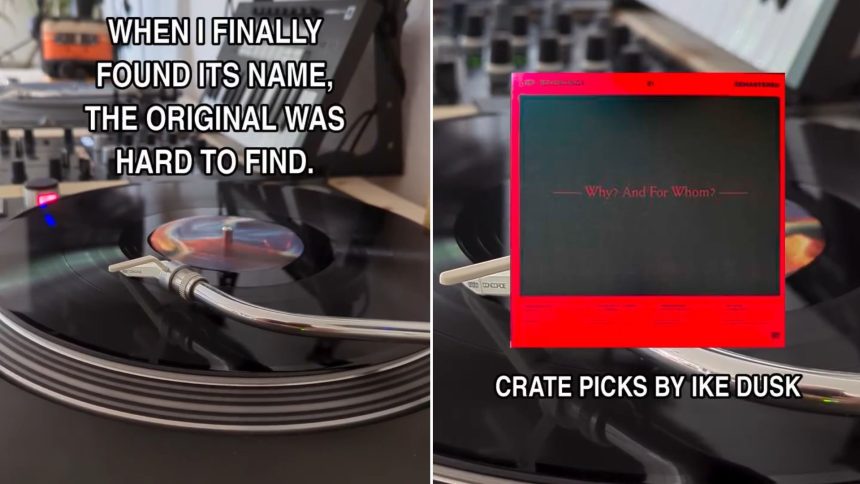
Some record hunts last a weekend, while others extend over years. Creator @ikedusk recently showcased a particularly lengthy pursuit when he celebrated the discovery of a rare techno vinyl record. In a captivating video, he spins the record on his turntable, allowing the music to fill the room while narrating his quest for this elusive piece of vinyl. The story of how he finally tracked down the record is not just a tale of perseverance; it encapsulates a profound connection to a rich cultural history rooted in London’s underground dance music scene of the early 1990s.
What makes this story compelling isn’t merely the successful acquisition of a rare record, although that is a significant achievement within vinyl collecting circles. The intriguing part arises from the sequence in which the discovery unfolded. Initially, he fell in love with the music itself, captivated by its rhythm and emotion long before he learned of its historical significance. This tells a relatable narrative for many music enthusiasts, who often find themselves enamored with a song before diving into its background, creating a personal connection that transcends the mere act of listening.
The underground London techno scene of the early 1990s is an essential chapter in electronic music history. It was a time when warehouse parties and intimate event series were the backbone of an emerging genre, setting the stage for techno’s evolution into a worldwide phenomenon. Figures like Steve Bicknell and Sheree Rashit played crucial roles in cultivating this underground scene, establishing themselves as legendary figures among serious techno aficionados. Their names may be less recognizable beyond dedicated communities, but for those immersed in the culture, they symbolize the very essence of the genre’s grassroots origins. A record linked to this era represents more than just a quality track; it embodies a pivotal moment in the evolution of dance music.
Vinyl collecting thrives on this kind of patient and obsessive pursuit. Unlike the instant gratification offered by digital streaming platforms, where virtually any track is just a quick search away, the hunt for physical records—particularly rare pressings from niche scenes or independent labels—often takes years of dedication, trading, and serendipitous finds in varying record shops. This scarcity adds an emotional charge to the experience, transforming a record hunted down over years into a celebrated artifact. Each scratch on its surface, each fingerprint on the sleeve tells a story that cannot be replicated by an instantaneous digital download.
Furthermore, this particular journey exemplifies how musical appreciation evolves. Many serious listeners find that their connection to a song deepens over time. Initially, a track might resonate purely on an emotional or sonic level, creating an immediate bond through its rhythm or mood. Only later does the fuller context emerge: understanding the artist’s background, the cultural moment it hailed from, and the scene that birthed it. This layered understanding enriches the experience, encoding a favorite track within the tapestry of an individual’s personal and cultural narrative.
For anyone intrigued by vinyl collecting or the broader landscape of music history, there is a substantial lesson to glean from a story like this. Investigating the backgrounds of tracks that resonate personally can enhance appreciation manifold. Discovering where a piece originated, the scene and creative minds behind it, and the chronology of its emergence can transform a beloved song into a component of a more extensive cultural narrative. This kind of inquiry requires only curiosity; no expertise is necessary. It might involve studying liner notes, perusing old interviews, or simply engaging with fellow collectors to piece together the narratives that surround cherished tracks.
Amid the backdrop of a society increasingly characterized by immediacy, this story also highlights the value of patience. The act of spending years pursuing a specific record—rather than opting for a quick digital version—embodies a commitment that often seems scarce in modern consumption habits. The moment when one finally places a hard-won record on a turntable is undeniably rewarding, as that experience is shaped not just by the music, but by the journey taken to reach it. This pursuit fosters a connection that cannot be replicated through digital means, as the barriers faced in finding the record contribute to its intrinsic worth.
Moreover, stories like @ikedusk’s are vital in preserving underground music history organically. Unlike mainstream music, which often receives formal recognition in the form of museums and archival programs, the history of scenes like early 90s London warehouse techno survives primarily through passionate collectors and enthusiasts. These individuals preserve and share the stories behind records, maintaining a living archive that keeps underground music’s legacy alive through personal connection and shared knowledge.
For newcomers curious about underground dance music history, narratives like this one serve as informative gateways. They remind us that within each vinyl record lies a treasure trove of history, enriched by the conversations and connections that echo through the years. The hunt for music, after all, is as much about the stories woven into each track as it is about the sounds themselves, bridging past and present through the love of collecting and sharing experiences.



