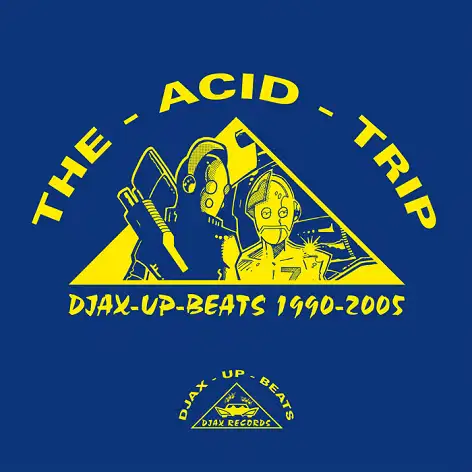
There are labels that document a scene, and then there are labels that help invent the sound of one.
Djax-Up-Beats belongs firmly in the second category.
The legendary Dutch imprint, founded in 1989 by Saskia Slegers, better known as Miss Djax, played a crucial role in shaping the sound of European acid techno during one of electronic music’s most explosive periods. At its peak, Djax-Up-Beats stood alongside labels such as Tresor, R&S, Soma and Peacefrog as one of the key forces pushing techno from underground warehouses into a wider international rave network.
Now, that legacy returns through Djax-Up-Beats 1990–2005: Volume 1 – The Acid Trip, a new retrospective compilation released by Delsin and curated by Rush Hour co-founder Christiaan Macdonald.
The title tells you exactly where this first chapter is headed.
This is a tribute to acid in its rawest and most physical form — the sound of the Roland TB-303 pushed into overdrive, twisting through warehouse spaces, illegal raves and sweat-soaked dancefloors with no interest in being polite.
During the early 1990s, Djax-Up-Beats became a vital bridge between Chicago, Detroit and Europe. The label connected American producers with a rapidly expanding European rave audience while also giving Dutch and Belgian artists space to stretch those influences into something harder, faster and more chaotic.
That exchange sits at the heart of The Acid Trip.
Across 14 tracks, the compilation captures acid techno not as a nostalgic museum piece, but as a living, unstable force — wild, functional, emotional and often beautifully rough around the edges.
Mike Dearborn’s “Raw Acid” is one of the clearest examples. Built from snapping drum machine pressure and a 303 line permanently pushed into the red, the track distills Chicago’s machine funk into something direct and punishing. There is no decoration here, only tension, repetition and pure acid drive.
Edge Of Motion’s “La Orilla” pushes into darker hypnotic territory, proving how effectively the label could turn simple rhythmic ideas into full-body warehouse pressure. Miss Djax herself appears with “Killer Train,” a track whose title perfectly matches its energy: fast, relentless and powered by a bassline that feels like it could derail at any second.
But what makes the compilation valuable is that it does not reduce Djax-Up-Beats to one single formula.
Yes, the label was deeply associated with hard, rave-ready acid techno. But its catalogue was far wider and stranger than that reputation sometimes suggests. In its first five years alone, Djax-Up-Beats released more than 120 records, creating a sprawling ecosystem where Chicago jack tracks, Detroit-inspired futurism, Dutch rave energy and experimental European machine music all collided.
That openness comes through clearly here.
Ismistik’s “Cassis,” produced by Bjørn Torske, moves through haunting and angular techno territory, offering a more atmospheric counterpoint to the compilation’s harder acid cuts. Hexagone’s “Burning Trash Floor,” connected to Ludovic Navarre of St Germain fame, leans more toward mutant Detroit psychedelia than straight Chicago acid, showing how fluidly the label allowed different interpretations of machine music to coexist.
Mike Dearborn’s second appearance, “Outer Limits (Trance Mixx),” also reveals another side of his sound. Instead of the brute force of “Raw Acid,” it moves into something more sensual, deeper and more heads-down — still functional, but less violent in its impact.
That range is important.
It reminds listeners that Djax-Up-Beats was never simply a label for acid tools. It was a meeting point for producers willing to test how far techno could bend while remaining physically connected to the dancefloor.
Tracks from China White and Phase Phorce bring that DIY energy even closer to the surface. Rough, strange and slightly mysterious, they sound like sketches captured straight to tape — imperfect, immediate and alive in a way that polished modern club music often is not.
That roughness is part of the charm.
The compilation captures a period when techno still felt dangerous because nobody fully knew where it was going. The rules had not yet hardened. The machines were affordable enough to misuse, and that misuse created entire musical languages.
The Roland TB-303 remains central to that story.
Originally designed as a failed bass accompaniment machine, it became one of the most important instruments in electronic music history because producers discovered how strange, elastic and psychedelic it could become when pushed beyond its intended purpose. Acid was born from that mistake — and Djax-Up-Beats helped turn that mistake into a European rave weapon.
By the mid-2000s, acid techno had largely lost its central position on many mainstream techno dancefloors. Minimalism, Berlin-style austerity and darker monochrome approaches pushed the 303 squelch further into specialist territory.
But listening to The Acid Trip now, the music does not feel outdated.
If anything, it feels refreshing.
There is humor in it. Dirt. Risk. Physicality. A kind of wild machine optimism that modern techno sometimes forgets.
Djax-Up-Beats 1990–2005: Volume 1 – The Acid Trip is not just a retrospective. It is a reminder of a time when techno sounded like wires overheating, rooms shaking and future music being invented in real time.
And decades later, that acid still burns.