
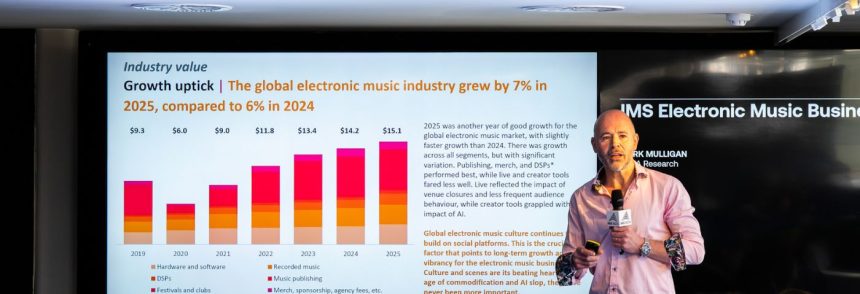
IMS Business Report 2025: Electronic Music Thrives with Robust Growth
The IMS Electronic Music Business Report for 2025 delivers an exciting outlook for the global electronic music industry, revealing a remarkable revenue generation of $15.1 billion. This figure represents a 7% year-on-year increase, showcasing an admirable trend of growth and resilience in a constantly evolving musical landscape. This twelfth edition of the report, compiled by MIDiA Research and unveiled at IMS Ibiza, underscores the electronic music genre’s ability to maintain relevance across diverse cultural contexts while navigating the ever-changing tides of technology and consumption.
Diversified Revenue Streams
One of the crucial insights from the report is the diversification of revenue streams within the electronic music sector. In 2025, recorded music revenues surged by 9%, while the publishing sector witnessed an 11% increase. This broad-based growth is indicative of a strategic shift away from dependency on singular revenue sources, highlighting the overall health of the music industry.
The expansion of streaming platforms plays a pivotal role, with global subscriber numbers now at 919 million. Notably, much of this growth owes itself to markets in the Global South, where increased access to digital streaming is recalibrating the geographic dynamics of the industry. Electronic music, in particular, has tapped into this wave, fostering a potent connection with international audiences.
Additionally, investor interest in electronic music is booming, with artists standing for 18% of catalogue acquisition deals in the current year. This trend reflects a commitment from investors toward newer catalogues perceived to have long-term streaming viability, especially among younger listeners.
Audience Growth and Platform Influence
The global fanbase for electronic music has burgeoned in 2025, adding 600 million followers across platforms like Spotify, YouTube, TikTok, Instagram, and Facebook. Despite showing a slower growth rate than previous years, this aligns with broader trends across major musical genres.
TikTok’s impact is notable, with the #ElectronicMusic hashtag garnering 3 million creations in 2025 — a 50% year-on-year increase. The rapid growth of niche subgenres is also evident; for instance, #SpeedGarage rose by 147%, while #Techno grew by 66%. In the UK, house and techno genres find themselves in the top ten music hashtags on the platform, underscoring the genre’s cultural relevance.
On SoundCloud, electronic music now dominates, constituting one in three uploads, a marked rise from one in four in 2020. This platform’s vibrancy is reflected in the growth of DJ set uploads, which shot up by 39% year-on-year in 2025, signaling a robust demand for underground music experiences.
Germany and the Global South Drive Streaming
Germany continues to solidify its status as the leading market for electronic music listeners, boasting a growth rate of 11% in key territories. The reach of electronic music now ranks within the top three genres across most major markets, showcasing its universal appeal.
Spotify statistics reveal that Germany has 604 million monthly listeners—this startling figure highlights the country’s profound influence within the electronic genre, with listeners outnumbering the actual population by more than seven times. Following Germany are the US, Australia, UK, and the Netherlands, all of which display impressive listener counts, affirming electronic music’s far-reaching impact.
Globally, the genre maintains a top ranking on Spotify in ten out of thirteen leading markets, underlining its competitive position against other dominant genres like hip-hop and Latin music.
Fans Are Unusually Devoted
The engagement levels of electronic music fans are especially noteworthy. According to MiDiA’s consumer research, these fans dedicate an average of 10.4 hours to listening weekly, alongside spending around $24 monthly on live events and $17 on recorded music. A staggering 74% of electronic music enthusiasts place importance on real-life connections, emphasizing their loyalty and community engagement—a sentiment that surpasses the broader population’s response.
Dance music fans, in particular, exhibit a unique attachment to shared experiences and community bonding, marking a defining characteristic of this genre’s culture.
Genre Trends & Live Sector Resilience
Examining genre-specific trends, tech house has emerged as the best-selling category on platforms like Beatport, reaffirming its longstanding appeal. Meanwhile, Afro house is rapidly growing in popularity, particularly among music producers and creators, indicating a shift toward newer and more diverse genres.
The live sector remains vibrant, as evidenced by Ibiza, where club ticketing revenues hit €160 million in 2025. This increases despite a reduction in the number of events, indicating that audiences are increasingly drawn to high-value experiences over sheer quantity.
AI: The Conversation That’s Here to Stay
The integration of AI technologies into music production has also gained prominence over recent years. Revenue growth from generative AI tools soared by 651% from 2023 to 2025, amounting to $333 million in revenue. Monthly active users of these tools reached 63 million, showcasing a paradigm shift in how music is being created—more individuals are engaging in AI-assisted workflows, making music production more accessible than ever.
Conversely, traditional music software revenues have seen a decline, suggesting a transformative shift within the creator economy that embraces accessible, AI-driven tools that lower barriers to entry for aspiring musicians.

Outlook for 2026
The IMS report suggests a cautiously optimistic trend for the future of electronic music. In an era dominated by AI-generated content and algorithmic streams, the strong notion of scenes culture—articulated through real-life connections, communal experiences, and underground creativity—will prove to be the bedrock of the genre’s resilience. As we move further into 2026, the significance of the dancefloor and live music experience appears more critical than ever, affirming electronic music’s unique cultural position in the global music landscape.
For an in-depth understanding of the electronic music landscape, the complete IMS Business Report can be downloaded here.
About the International Music Summit (IMS)
The International Music Summit (IMS) is an annual conference dedicated to exploring the business, culture, and technology driving the electronic music sector. Centered in Ibiza, the summit gathers industry professionals, artists, and businesses to engage in discussions about the ongoing trends and developments shaping the landscape of global electronic music. For more information, visit the official IMS website here.
Written by Eric Brünjes, April 24, 2026