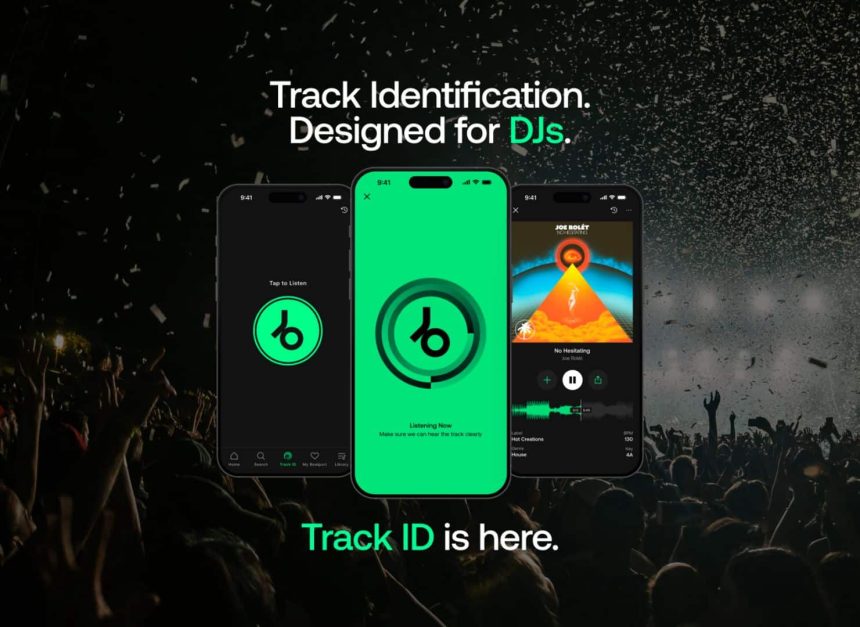
Beatport has officially launched Track ID, a new music recognition feature integrated directly into its mobile app, aiming to help DJs and fans identify tracks playing in clubs, DJ sets and mixes in real time.
Released on May 12 for both iOS and Android, Beatport Track ID enters a space already dominated by services like Shazam and Google’s music recognition tools — platforms that have been identifying songs for years with impressive speed and accuracy.
So the obvious question immediately becomes:
why does Beatport believe DJs need another track recognition app?
According to Beatport, the answer is context.
Unlike general-purpose recognition software designed mainly for radio songs or clean audio environments, Beatport Track ID was specifically engineered for club conditions — spaces where heavy bass, crowd noise, overlapping transitions and pitch-shifted blends often confuse standard music recognition systems.
That distinction could become the feature’s biggest strength if it performs as promised.
Inside the Beatport app, users simply tap the Track ID icon and allow the software to listen through the device microphone. Identified tracks then appear immediately for preview, while also saving into a personal Track ID history connected directly to the user’s Beatport account.
From there, tracks can be purchased, downloaded or added to playlists and libraries without needing to switch platforms.
Technically, the system was developed alongside seeqnc, an AI music recognition company operating between Vienna and Berlin that specializes in large-scale copyright identification and monetization systems.
That partnership adds serious credibility to Beatport’s ambitions — especially because this may ultimately become about much more than simply discovering tracks on dancefloors.
The potentially more important aspect lies in royalties.
Beatport’s Chief Revenue Officer Helen Sartory framed Track ID not only as a discovery tool, but as the beginning of a broader infrastructure capable of improving setlist reporting and live performance royalty collection.
That problem has existed inside dance music for decades.
Huge amounts of music played inside clubs and festivals globally generate no accurate performance reporting data, meaning many producers never receive royalties connected to how often their tracks are actually played by DJs.
If Beatport Track ID can reliably track songs used during real-world performances, the system could eventually help build a more transparent reporting structure between DJs, clubs, rights organizations and producers themselves.
That possibility makes the feature significantly more interesting than simply “Beatport’s version of Shazam.”
The timing also matters.
DVS1’s Aslice platform attempted to create new royalty-sharing infrastructure for electronic music artists before shutting down in 2024, largely due to financial sustainability challenges and slow industry-wide adoption.
Beatport, however, operates from a much stronger position.
Unlike independent startup projects, Beatport already controls one of electronic music’s largest digital catalogs while maintaining direct relationships with DJs, labels and producers globally. That ecosystem gives the company a much stronger chance of successfully integrating discovery and royalty tracking into one functional platform.
Still, adoption remains the biggest challenge.
Shazam is already deeply embedded into user habits. Most DJs already instinctively reach for it when hearing an unknown track. Convincing people to instead open Beatport’s app inside dark clubs or during busy sets requires behavioral change — something technology alone rarely guarantees.
Ultimately, Beatport Track ID enters a category that has largely been solved for casual listeners, but not fully solved for club culture itself.
If the feature can genuinely recognize tracks more accurately inside real dancefloor conditions while also helping producers receive better royalty recognition, Beatport may have found something much bigger than another music recognition tool.
It may have found the foundation for a new layer of electronic music infrastructure.