
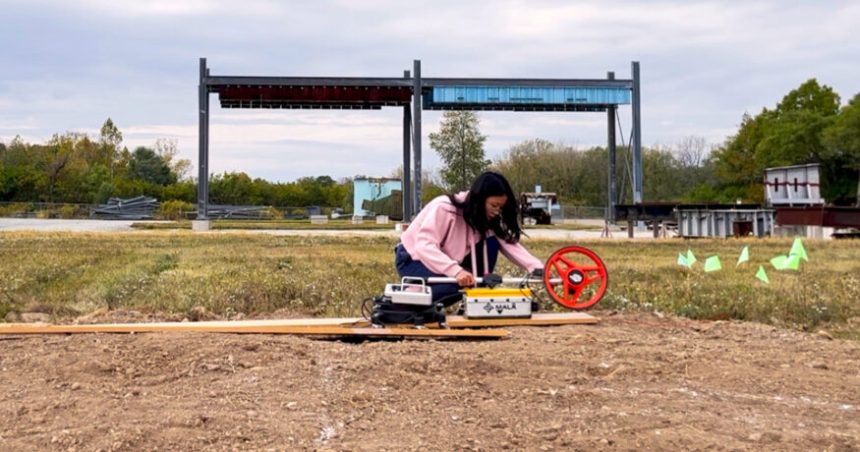
Advancing Safety: Purdue University’s Patent-Pending Technology for Underground Utility Strikes
Underground utility strikes pose significant risks during construction projects. Even with advances in technology, incidents continue to happen, leading to costly damages and potential injuries. However, engineers at Purdue University are on a mission to change that narrative. Through innovative research, they have developed a patent-pending method designed to decrease hazardous strikes to underground utility pipes, presenting a significant leap toward safer construction environments.
The Team Behind the Innovation
The project is spearheaded by Hubo Cai, a professor and the associate head of Purdue’s Lyles School of Civil and Construction Engineering, along with Yuxi Zhang, a dedicated doctoral candidate in civil engineering. The duo has extensively researched traditional ground-penetrating radar (GPR) systems, which have been the go-to method for locating underground utilities. Their findings aim to address the shortcomings of existing GPR technologies and improve the accuracy and reliability of underground utility mapping.
Enhancing Ground-Penetrating Radar Data
Ground-penetrating radar operates by sending electromagnetic waves into the ground and analyzing how these waves reflect off various subsurfaces. Although GPR is a non-invasive approach to locating pipes, it often struggles with uncertainties and data quality issues. Cai emphasizes that these limitations can lead to inaccurate interpretations, resulting in dangerous excavations.
To tackle this issue, Cai and Zhang have devised an “uncertainty-aware model.” This innovative approach allows for a robust quantification of uncertainty, effectively creating a safety buffer zone around utility pipe locations. By offering clearer insights into utility features such as orientation and radius, this method significantly enhances the interpretative capabilities for contractors and utility-locating services.
Validation Through Advanced Frameworks
The strength of this new technology comes from the researchers’ use of a Bayesian framework, which allows for an accurate quantification of uncertainty when estimating essential parameters like underground pipe depth and position. This framework generates credible intervals and offers reliability measures for estimates.
Cai notes that they developed a forward model that predicts electromagnetic wave travel times from three-dimensional pipe geometries. Early results show that it achieves a root mean square error (RMSE) of just 0.454 nanoseconds when compared with high-fidelity simulations—an impressive feat indicating strong predictive accuracy that maintains reduced computational costs.
Industry-Wide Implications
The implications of Cai and Zhang’s research extend far beyond just academic achievement. The Common Ground Alliance has estimated that underground infrastructure damage costs the United States around $30 billion each year. Alarmingly, nearly 88% of these incidents stem from inaccurate location data. Inaccurate records not only result in financial losses but also create bottlenecks in transportation projects. Utility conflicts during construction can lead to cost overruns, delays, safety concerns, and service outages.
According to Zhang, successful identification and management of utility conflicts are crucial for enhancing public safety and ensuring project timelines. Effective tools that can accurately locate underground piping are the first steps toward creating a comprehensive “digital twin” of the vast underground infrastructure.
Collaboration with Technology Commercialization
Once their findings were established, Cai and Zhang disclosed their innovation to the Purdue Innovates Office of Technology Commercialization, which has already initiated a patent application process to protect their intellectual property. Industry partners interested in developing or commercializing the algorithm can reach out for collaboration opportunities, ensuring that their groundbreaking research benefits a broader audience.
Support and Funding
This groundbreaking research has received support through a grant from the National Science Foundation, underscoring the importance of funding and institutional backing in advancing technological innovations that address real-world challenges.
Purdue University’s Commitment to Innovation
The Purdue Innovates Office of Technology Commercialization is an essential player in the university’s efforts to transition research from the lab to real-world applications. This vibrant office operates one of the most comprehensive technology transfer programs among leading research institutions in the U.S. By commercializing, licensing, and protecting intellectual property, it aids in the economic development promises of Purdue while enhancing academic initiatives.
As Purdue University continues to explore the realms of possibility through engineering and technology, it sets a benchmark for others in the field. By focusing on practical solutions that address crucial challenges—like underground utility strikes—the institution exemplifies its commitment to fostering innovation that prioritizes public safety and efficiency in construction practices.
This article highlights the significant strides being made at Purdue University to mitigate the dangers posed by underground utility strikes through advanced technology. By bringing attention to these efforts and their broader implications, it provides a glimpse into a safer and more efficient future for construction industries.