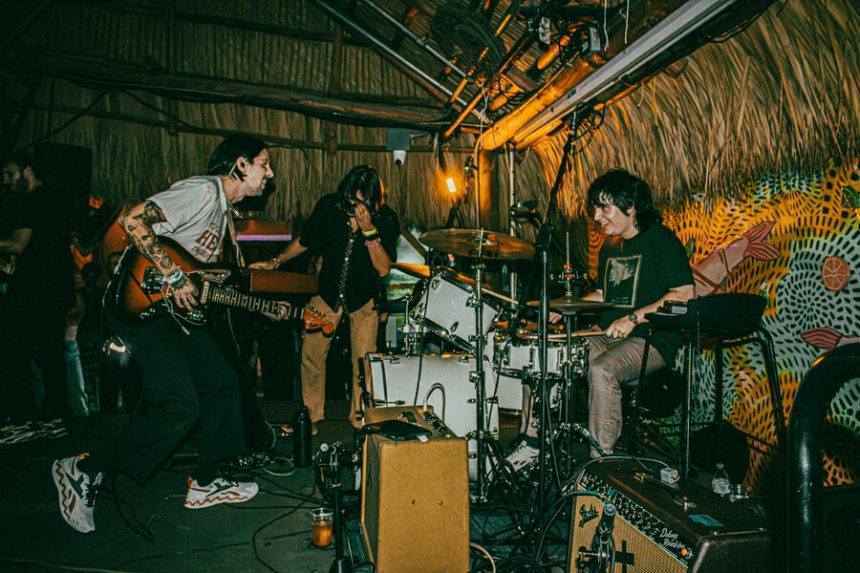
The band also explains the importance of places like Sweat Records in the expansion of the scene, and the now-defunct venue Churchill’s Pub, where Perez says crowds were growing over the years from regulars to bigger groups.
Aside from one of their friends who managed to squeeze several hundred in his backyard for events, most of the gigs from rising acts were held in spaces in the outskirts of the city that had the “spirit” of house shows (“because Latino parents don’t let their kids throw parties,” Rivero Ochoa jokes), taking over spaces like dance studios after hours; warehouses, including one called Lucid Gallery; and storage units.
“People would rent out a storage unit for a month and one weekend would be rap night, another weekend would be psychedelic rock, another weekend would be everything mixed,” River Ochoa explains.
That sonic diversity is what Mustard Service identifies as the most unique aspect of the Miami scene—and perhaps what’s most worth celebrating. A reputation for clubbing, lack of smaller music venues, and Miami’s location in a difficult region to tour, “kind of forced the Miami sound to be eclectic,” Marinuchi says.
“Sometimes you’ll say, ‘They have an LA sound,’ ‘They have a Brooklyn sound,’ but here it’s a free-for-all,” the guitarist shares. “We’ll have the hardcore band, the indie band, and then the folk band all playing together.”
Cattani chimes in, “I’ve been to shows where a punk band opens for an indie band, which then opens for a ska band”—only for Rivero Ochoa to interject with, “We’ve played those shows.”
“And then there’s a rapper somewhere in there,” Cattani continues, with Perez adding, “And a DJ set at 1 am.”
That eclecticism is what they love about their scene and one of the main reasons they’ve stayed, in addition to reasons like financial stability, comfort, and their love for the city’s Latin culture. In fact, all of Mustard Service comes from Latin descent, and they constantly find themselves inspired by the Latin music they hear throughout Miami.
“Some of the best musicians that I’ve seen play live were playing salsa,” Roberto Ochoa says. “Sometimes you’ll randomly catch a set of salsa musicians in some corner playing, and they’re incredible. They can be playing to five people, but they love the music so much that they would play to zero. For me, that’s super inspiring.”
There are many reasons Mustard Service loves their city, but the band themselves are a reason to love Miami, too. They’re among the musicians continuing to make the scene all the more eclectic and give it the space to thrive with projects like Zest Fest. If you make it to this year’s, you’re sure to see that energy radiating from the band and the rest of the bill as they take the bandshell stage.